← All plants
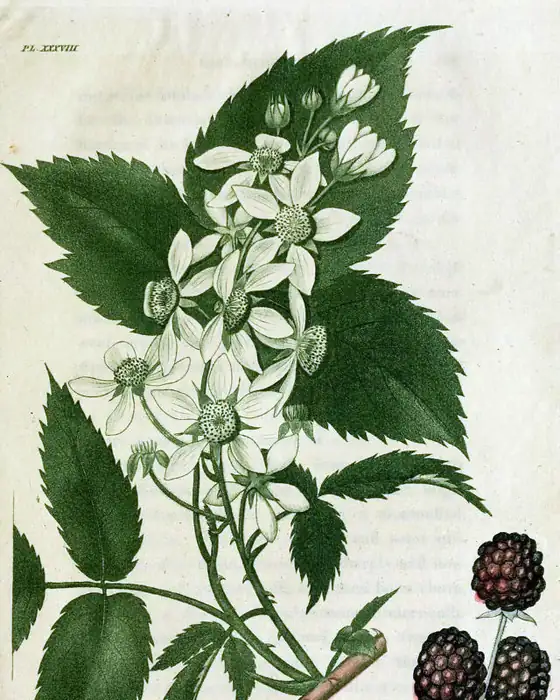
Archival plate of Rubus fruticosus, R. villosus, from Bigelow, American Medical Botany, 1817 to 1820
The Moss Herbal Database
Rubus fruticosus, R. villosus
Fam. Rosaceae
Parts: Root bark, leaves, and berries
Plate: Bigelow, American Medical Botany, 1817 to 1820 ↗

Blackberry

Rubus fruticosus, R. villosus
Also: Bramble, Dewberry
CoolingDryingTonifying

A bramble astringent for loose bowels, with berries for the larder.

The thorny, arching bramble of hedgerows and clearings, with white or pink flowers and glossy black fruit. Blackberry leaf and root bark are strong astringents that firm loose bowels and tone weepy tissue, and the berries are rich in antioxidant pigments.

Energetics
Cooling, drying, toning
Taste
Astringent, sour
Family
Rosaceae (rose family)
Parts used
Root bark, leaves, and berries

Medicinal uses 4

The tags sort the evidence behind each use by kind. Members are able to tap a condition to compare every herb for it.

Traditional useLab and mechanism studiesClinical studies
  • The root bark, the strongest part, firms loose bowels quickly; the leaf is gentler.

  • A leaf gargle tightens a sore throat.

  • A leaf rinse for bleeding gums and mouth sores.

  • Leaf and root move excess fluid out through the kidneys.

Preparations

Root bark decoction for short use, leaf tea and gargle, and berry cordial.

Members are able to see the amounts, ratios, and methods for each preparation, search by condition, and match herbs to your constitution.

Cautions

  • The root bark dries strongly; keep it to a few days.
  • Its tannins can bind medicines and iron taken at the same time; space them a couple of hours apart.
  • Diarrhea that lasts more than a couple of days, or comes with fever or blood, needs medical care.

Medication interactions

Practitioner Practitioners are able to see the 2 types of medicine flagged for blackberry, each with the mechanism and what to do. The plain-language cautions above stay open to everyone.

Pregnancy & breastfeeding

PregnancyFruit and leaf tea

The fruit is a wholesome pregnancy food, and the leaf has no known action on the uterus, unlike its cousin raspberry leaf. Leaf data are limited, so keep to tea amounts.

BreastfeedingFruit and leaf tea

The fruit and the leaf tea are generally considered compatible.

Practitioner Practitioners are able to see the full entry from the Moss Herbalism Pregnancy Safety Database: trimester ratings, uterine and placental action, breastfeeding and nursing-baby effects, chemistry, traditional use, studies, and sources.

Folklore

English folklore warns against picking blackberries after Michaelmas, when the Devil, cast out of heaven into a bramble patch, spoils the berries every year. A bramble that had arched over and rooted at both ends was thought to cure whooping cough, boils, and ruptures if a sick child was passed beneath it. Botanists count hundreds of blackberry microspecies, because many set seed without fertilization and so clone themselves.

How to grow

A vigorous, thorny bramble for sun and almost any soil; the canes fruit in their second year, and thornless varieties are kinder in a garden. Dig root bark in autumn and pick leaves before flowering.

In the wild

Hedgerows, clearings, and roadsides across Europe and North America. In the Pacific Northwest, the introduced Himalayan blackberry has overrun much of the lowlands.

Every herb here fits some people better than others. Find out which ones fit you.