← All plants
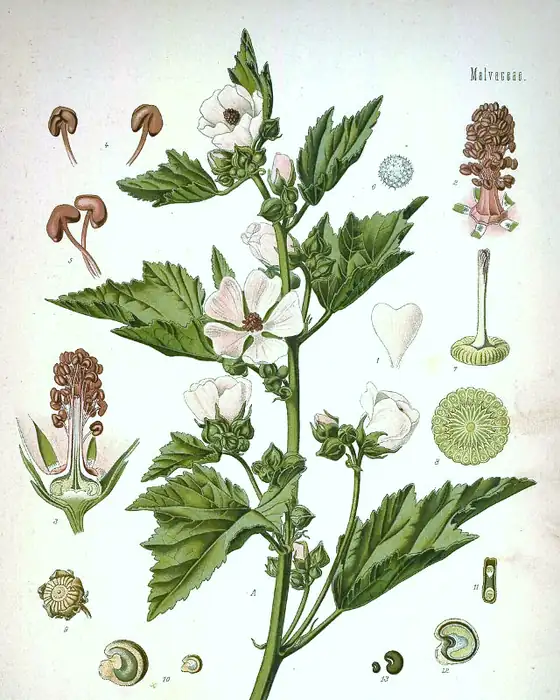
Archival plate of Althaea officinalis, from Köhler's Medizinal-Pflanzen, 1887 to 1898
The Moss Herbal Database
Althaea officinalis
Fam. Malvaceae
Parts: Root and leaf
Plate: Köhler's Medizinal-Pflanzen, 1887 to 1898 ↗

Marshmallow

Althaea officinalis
Also: Marsh mallow, Althea
CoolingMoisteningRelaxing

A slippery root that brings moisture back to dry, burning tissue.

A tall, velvet-leaved mallow of salt marshes with pale pink flowers. Its root and leaf are rich in mucilage, a slippery coating that soothes, moistens, and protects every mucous membrane it reaches, and helps water stay in a body that loses it too fast.

Energetics
Cold, moistening, relaxing
Taste
Sweet, bland, slippery
Family
Malvaceae (mallow family)
Parts used
Root and leaf

Medicinal uses 7

The tags sort the evidence behind each use by kind. Members are able to tap a condition to compare every herb for it.

Traditional useLab and mechanism studiesClinical studies

Preparations

An overnight cold infusion of the root, leaf tea for the lungs, and poultices.

Members are able to see the amounts, ratios, and methods for each preparation, search by condition, and match herbs to your constitution.

Cautions

  • Its mucilage slows absorption of medications taken at the same time; keep them at least two hours apart.

Medication interactions

Practitioner Practitioners are able to see the 2 types of medicine flagged for marshmallow, each with the mechanism and what to do. The plain-language cautions above stay open to everyone.

Pregnancy & breastfeeding

PregnancyGenerally compatible

One of the safer herbs, with no uterine activity and a strong traditional record. Keep it two hours apart from any medications.

BreastfeedingGenerally compatible

Generally considered compatible at usual tea amounts.

Practitioner Practitioners are able to see the full entry from the Moss Herbalism Pregnancy Safety Database: trimester ratings, uterine and placental action, breastfeeding and nursing-baby effects, chemistry, traditional use, studies, and sources.

Folklore

Confectioners in nineteenth-century France whipped marshmallow root sap with sugar and egg whites into pâte de guimauve, a soft lozenge for sore throats, and the modern marshmallow kept the name after gelatin replaced the root. The genus name Althaea comes from the Greek althaino, to heal. Charlemagne's estate decree of around 800, the Capitulare de villis, lists it among the plants to be grown in the royal gardens.

How to grow

A hardy perennial for moist soil in full sun, reaching 4 to 5 feet. It tolerates salty, damp ground. Dig roots in autumn of the second year and dry them in slices.

In the wild

Salt marshes, damp meadows, ditches, and riverbanks of Europe, western Asia, and North Africa, naturalized in the salt marshes of eastern North America. Common mallow, a garden weed, works in similar ways.

Every herb here fits some people better than others. Find out which ones fit you.