← All plants
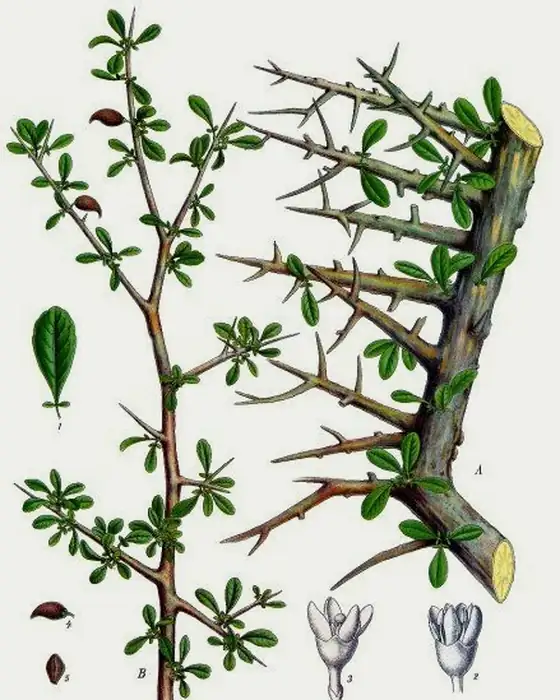
Archival plate of Commiphora myrrha, from Köhler's Medizinal-Pflanzen, 1887 to 1898
The Moss Herbal Database
Commiphora myrrha
Fam. Burseraceae
Parts: Resin
Plate: Köhler's Medizinal-Pflanzen, 1887 to 1898 ↗

Myrrh

Commiphora myrrha
Also: Gum myrrh, Commiphora molmol
WarmingDryingTonifying

A bitter resin that tightens and disinfects mouths, throats, and skin.

Reddish-brown tears of resin bled from the slashed bark of a small, thorny desert tree. Myrrh is a strong antimicrobial astringent, used mostly on the skin and in the mouth and throat, where it firms slack, inflamed tissue and fights infection.

Energetics
Hot, drying, toning
Taste
Bitter, resinous, aromatic, astringent
Family
Burseraceae (frankincense family)
Parts used
Resin

Medicinal uses 5

The tags sort the evidence behind each use by kind. Members are able to tap a condition to compare every herb for it.

Traditional useLab and mechanism studiesClinical studies

Preparations

Strong-alcohol tincture, gargles and rinses, salves, and tooth powder.

Members are able to see the amounts, ratios, and methods for each preparation, search by condition, and match herbs to your constitution.

Cautions

  • Taken by mouth, keep to small doses for short periods; large doses can upset the stomach, kidneys, and heart.
  • Herbalists leave it out during a fever and other hot, inflamed states.
  • Use the resin or its tincture; the essential oil is very concentrated and carries only part of the resin's action.
  • It may lower blood sugar and change how warfarin works; check with your prescriber.

Medication interactions

Practitioner Practitioners are able to see the 2 types of medicine flagged for myrrh, each with the mechanism and what to do. The plain-language cautions above stay open to everyone.

Pregnancy & breastfeeding

PregnancyAvoid

Myrrh is a classic emmenagogue that stimulates the uterus, recorded across many traditions, so it is avoided throughout pregnancy.

BreastfeedingAvoid

Its action on the uterus keeps it out of nursing.

Practitioner Practitioners are able to see the full entry from the Moss Herbalism Pregnancy Safety Database: trimester ratings, uterine and placental action, breastfeeding and nursing-baby effects, chemistry, traditional use, studies, and sources.

Folklore

Myrrh is among the oldest traded resins. Egyptian expeditions sailed to the Land of Punt for it, and Queen Hatshepsut's temple at Deir el-Bahari shows incense trees being carried home in baskets around 1470 BCE. Egyptians burned it in kyphi, their temple incense, and used it in embalming. Its name comes from the Semitic root for bitter, shared by the Hebrew mor and the Arabic murr.

How to grow

A small, thorny desert tree that needs heat and very dry, well-drained ground and will not survive frost. Harvesters cut the bark, and the pale yellow sap that wells up hardens over weeks into reddish-brown tears.

In the wild

Rocky, arid hills around the Horn of Africa and the southern Arabian Peninsula, in Somalia, Ethiopia, Kenya, Yemen, and Oman.

Every herb here fits some people better than others. Find out which ones fit you.