← All plants
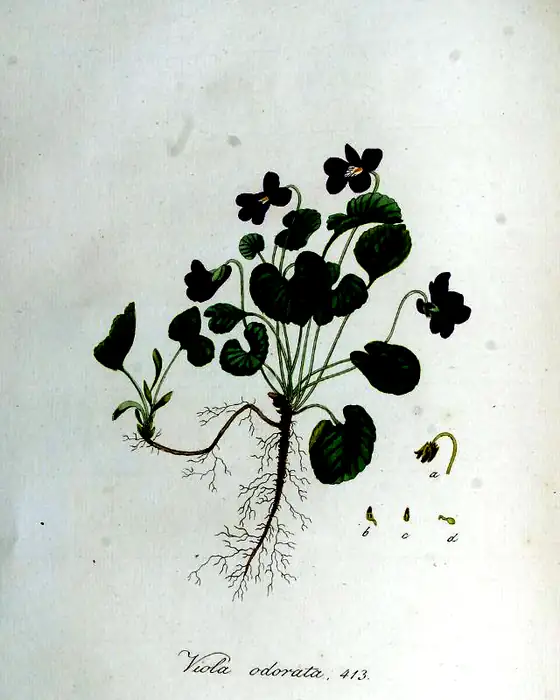
Archival plate of Viola odorata, from Flora Batava, vol. 6
The Moss Herbal Database
Viola odorata
Fam. Violaceae
Parts: Leaves and flowers
Plate: Flora Batava, vol. 6 ↗

Violet

Viola odorata
Also: Sweet violet, English violet
CoolingMoisteningRelaxing

Moves lymph without drying, and calms a dry, fluttering heart.

A low spring flower with heart-shaped leaves and nodding purple blooms that smell sweet and powdery. Violet cools and moistens: it keeps lymph moving where most lymph herbs would dry, and it soothes dry skin, a dry cough, and a nervous, fluttery heart.

Energetics
Cooling, moistening, relaxing
Taste
Sweet, mild, green
Family
Violaceae (violet family)
Parts used
Leaves and flowers

Medicinal uses 6

The tags sort the evidence behind each use by kind. Members are able to tap a condition to compare every herb for it.

Traditional useLab and mechanism studiesClinical studies
  • Moves lymph in swollen glands and congested tissue while adding moisture, a rare pairing among lymph herbs.

  • Cool-water infusions, as baths and compresses, calm eczema and dry, flaky psoriasis.

  • Coats and softens a dry, tickling cough; violet syrup is an old children's cough remedy.

  • Settles agitation and restlessness in people who run dry.

  • Soothes palpitations in dry, wiry constitutions.

  • The flower syrup is a gentle laxative suited to children.

Preparations

Leaf and flower tea, cool-water infusions for skin, flower syrup, and spring salads.

Members are able to see the amounts, ratios, and methods for each preparation, search by condition, and match herbs to your constitution.

Cautions

  • Very gentle, and suited to children and elders.
  • Use the leaves and flowers; the root is a strong purgative.
  • African violets are an unrelated houseplant. Heartsease (Viola tricolor) can stand in for sweet violet.

Pregnancy & breastfeeding

PregnancyFood and tea amounts

Violet leaves and flowers are eaten as a spring food, and herbalists count violet among the gentlest herbs. Pregnancy has not been studied, so keep to food and tea amounts, and leave the purgative root alone.

BreastfeedingFood and tea amounts

Food and tea amounts of leaf and flower are a long-standing use; nursing has not been studied.

Folklore

Athens took the violet as its emblem, and the poet Pindar called the city violet-crowned. When Napoleon was exiled to Elba he promised to return with the violets in spring, and his followers wore them as a secret sign and toasted him as Corporal Violet. The flower's scent molecule, ionone, briefly switches off the nose's receptors for it, so the perfume fades and returns in waves.

How to grow

A shade-tolerant perennial for rich, moist soil under shrubs and along paths, spreading by runners and by seed. Gather leaves and flowers in spring while it blooms. Later in the year it makes small, closed flowers near the ground that pollinate themselves without opening and set most of the seed, and ants carry the seeds off for the oily tag attached to each one.

In the wild

Native to Europe and western Asia, and naturalized in lawns, hedgerows, and woodland edges across North America. North America's native common blue violet (Viola sororia) is scentless and carpets lawns and shady yards across the East.

Every herb here fits some people better than others. Find out which ones fit you.