← All plants
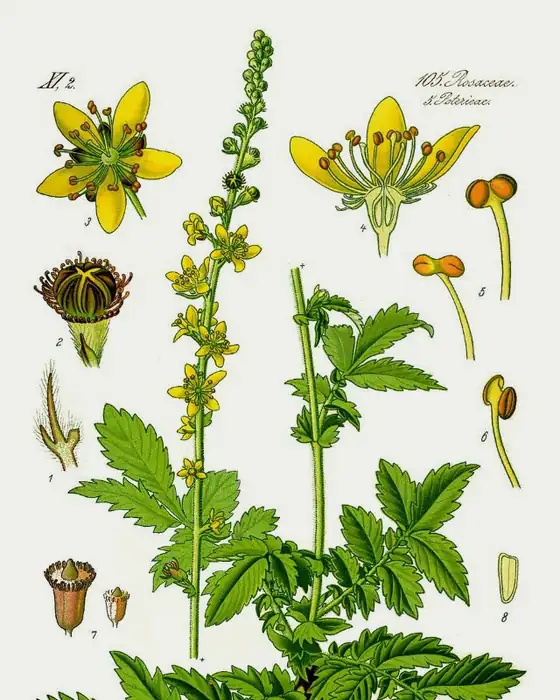
Archival plate of Agrimonia eupatoria, from Thomé, Flora von Deutschland, Österreich und der Schweiz, 1885
The Moss Herbal Database
Agrimonia eupatoria
Fam. Rosaceae
Parts: Aerial parts in flower
Plate: Thomé, Flora von Deutschland, Österreich und der Schweiz, 1885 ↗

Agrimony

Agrimonia eupatoria
Also: Church steeples, Sticklewort, Common agrimony
WarmingDryingTonifying

Tightens leaky tissue from the throat to the bladder.

A downy perennial whose slender spires of small yellow flowers turn into hooked burrs that catch on socks and fur. Agrimony is a gentle astringent and bitter: it tones loose, leaking mucous membranes in the gut, throat, and urinary tract, and stirs a sluggish liver.

Energetics
Warming, drying, toning
Taste
Astringent, bitter, faintly sour and floral
Family
Rosaceae (rose family)
Parts used
Aerial parts in flower

Medicinal uses 7

The tags sort the evidence behind each use by kind. Members are able to tap a condition to compare every herb for it.

Traditional useLab and mechanism studiesClinical studies

Preparations

Tea, gargle, tincture, and washes.

Members are able to see the amounts, ratios, and methods for each preparation, search by condition, and match herbs to your constitution.

Cautions

  • Large amounts can constipate.
  • Its tannins reduce iron absorption; take iron supplements a couple of hours apart.

Medication interactions

Practitioner Practitioners are able to see the 3 types of medicine flagged for agrimony, each with the mechanism and what to do. The plain-language cautions above stay open to everyone.

Pregnancy & breastfeeding

PregnancyTea amounts

Agrimony has no known action on the uterus, and European herbalists have long given it for digestive upsets in pregnancy. Research is limited, so keep to tea amounts.

BreastfeedingTea amounts

Generally considered compatible as tea.

Practitioner Practitioners are able to see the full entry from the Moss Herbalism Pregnancy Safety Database: trimester ratings, uterine and placental action, breastfeeding and nursing-baby effects, chemistry, traditional use, studies, and sources.

Folklore

Eupatoria honors Mithridates VI Eupator, the king of Pontus remembered for his antidotes. An old English medical manuscript warns that a sprig laid under a sleeper's head keeps them asleep until someone takes it away. Arquebusade water, distilled with agrimony among other herbs, was dabbed on wounds from early handguns. In the 1930s Edward Bach made agrimony one of his flower remedies, for people who hide their troubles behind a cheerful face.

How to grow

A hardy perennial for sun or light shade and ordinary, well-drained soil, reaching two to three feet. Sow in spring or divide clumps in autumn. Cut the stems when the spires are about half in flower, before the burrs form.

In the wild

Field edges, hedge banks, roadsides, and dry grassland across Europe, western Asia, and North Africa. North America has native agrimonies of its own in thickets and woodland edges.

Every herb here fits some people better than others. Find out which ones fit you.