← All plants
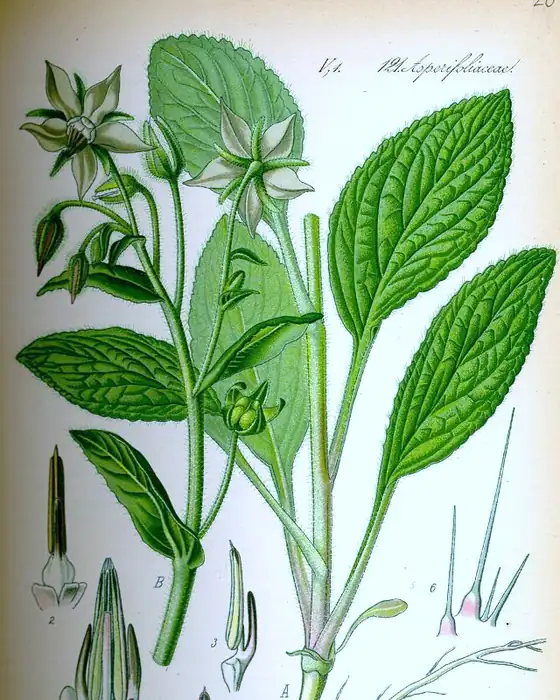
Archival plate of Borago officinalis, from Thomé, Flora von Deutschland, Österreich und der Schweiz, 1885
The Moss Herbal Database
Borago officinalis
Fam. Boraginaceae
Parts: Leaves, flowers, and seed oil
Plate: Thomé, Flora von Deutschland, Österreich und der Schweiz, 1885 ↗

Borage

Borago officinalis
Also: Starflower, Burrage
CoolingMoisteningRelaxing

A cucumber-scented herb of courage and comfort, with a healing seed oil.

A bristly annual with drooping, star-shaped flowers of a startling blue and a fresh cucumber smell in its leaves. Borage cools and comforts frayed nerves and low spirits, and the oil pressed from its seeds is the richest plant source of gamma-linolenic acid (GLA), which calms inflammation.

Energetics
Cooling, moistening, relaxing
Taste
Cucumber-like, faintly salty
Family
Boraginaceae (borage family)
Parts used
Leaves, flowers, and seed oil

Medicinal uses 4

The tags sort the evidence behind each use by kind. Members are able to tap a condition to compare every herb for it.

Traditional useLab and mechanism studiesClinical studies
  • Borage seed oil, rich in GLA, eased the pain and swelling of rheumatoid arthritis in clinical trials.

  • A traditional cordial for low spirits and grief, said to bring courage.

  • Restores nerves worn thin by long stress, including after childbirth, in short courses.

  • The seed oil, taken or applied, soothes dry, inflamed skin.

Preparations

Short courses of leaf tea, PA-free seed oil capsules, and fresh flowers in food and drink.

Members are able to see the amounts, ratios, and methods for each preparation, search by condition, and match herbs to your constitution.

Cautions

  • The leaves contain small amounts of pyrrolizidine alkaloids, which strain the liver. Keep leaf tea to short courses, leave it out with liver disease, and choose seed oil certified PA-free.
  • The bristly fresh leaves can irritate skin.
  • Seed oil may slow clotting and, rarely, lower the seizure threshold; check with your prescriber.

Medication interactions

Practitioner Practitioners are able to see the 3 types of medicine flagged for borage, each with the mechanism and what to do. The plain-language cautions above stay open to everyone.

Pregnancy & breastfeeding

PregnancyAvoid the leaf

The leaves carry low levels of pyrrolizidine alkaloids, so they are left out of pregnancy. The seed oil has too little pregnancy research to recommend; a few flowers as garnish are a food use.

BreastfeedingSeed oil only

Seed oil is generally considered compatible and supplies GLA, but the leaves and stems, with their alkaloids, are avoided while nursing.

Practitioner Practitioners are able to see the full entry from the Moss Herbalism Pregnancy Safety Database: trimester ratings, uterine and placental action, breastfeeding and nursing-baby effects, chemistry, traditional use, studies, and sources.

Folklore

Old herbals repeat the Latin tag ego borago gaudia semper ago, I, borage, always bring joy, and Pliny called it euphrosinum because it made people merry. Crusaders were said to drink borage in their stirrup cups before riding out. Its flowers open pink and turn blue, and bees work them so steadily that beekeepers sow borage near their hives.

How to grow

An easy, fast annual for sun and almost any soil. Sow it where it is to grow, since the taproot resents moving, and it will self-sow for years. Pick young leaves before flowering and flowers as they open.

In the wild

Native to the Mediterranean and naturalized in gardens, field edges, and waste ground across Europe and North America.

Every herb here fits some people better than others. Find out which ones fit you.