← All plants
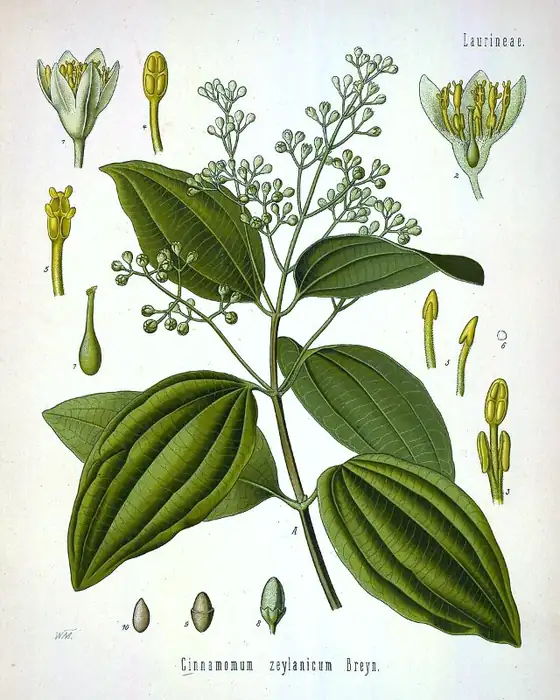
Archival plate of Cinnamomum verum, from Köhler's Medizinal-Pflanzen, 1887 to 1898
The Moss Herbal Database
Cinnamomum verum
Fam. Lauraceae
Parts: Inner bark
Plate: Köhler's Medizinal-Pflanzen, 1887 to 1898 ↗

Cinnamon

Cinnamomum verum
Also: Ceylon cinnamon, Cassia, Cinnamomum cassia, Cinnamomum zeylanicum
WarmingMoisteningTonifying

Warms cold hands and steadies blood sugar.

The curled inner bark of an evergreen tree of the laurel family, peeled from young shoots and rolled into quills as it dries. Cinnamon warms cold digestion and cold extremities and steadies blood sugar, and steeped in water it turns slightly slippery and soothing, unusual for a warming spice.

Energetics
Warming, moistening, toning
Taste
Pungent, sweet, astringent
Family
Lauraceae (laurel family)
Parts used
Inner bark

Medicinal uses 6

The tags sort the evidence behind each use by kind. Members are able to tap a condition to compare every herb for it.

Traditional useLab and mechanism studiesClinical studies

Preparations

Simmered sticks and chips, powder with food, and warming blends.

Members are able to see the amounts, ratios, and methods for each preparation, search by condition, and match herbs to your constitution.

Cautions

  • Cinnamon lowers blood sugar, sometimes within a week. If you take insulin or metformin, check your sugar every day and let your doctor know as the readings drop, since your dose may need to come down.
  • Cassia carries coumarin, which can strain the liver. With liver disease, keep cassia under 2 grams a day, about 2/3 teaspoon, or use Ceylon cinnamon.
  • Cassia may thin the blood; take care alongside blood thinners. The essential oil burns skin and mucous membranes.

Medication interactions

Practitioner Practitioners are able to see the 3 types of medicine flagged for cinnamon, each with the mechanism and what to do. The plain-language cautions above stay open to everyone.

Pregnancy & breastfeeding

PregnancyCulinary amounts

Cinnamon in food is a normal part of pregnancy. High-dose supplements wait, since cassia's coumarin can strain the liver, and the essential oil is avoided.

BreastfeedingCulinary amounts

Kitchen amounts are considered compatible while nursing; avoid the essential oil.

Practitioner Practitioners are able to see the full entry from the Moss Herbalism Pregnancy Safety Database: trimester ratings, uterine and placental action, breastfeeding and nursing-baby effects, chemistry, traditional use, studies, and sources.

Folklore

Herodotus repeated the story that cinnamon sticks were gathered from the nests of great birds in Arabia, brought down by baiting them with joints of meat, a tale Arab traders may have spread to hide their sources. Cinnamon and cassia appear in the Hebrew Bible's holy anointing oil. For three centuries the Portuguese, then the Dutch, then the British fought over the cinnamon gardens of Sri Lanka.

How to grow

A tropical evergreen for frost-free gardens or a warm, bright room. Growers coppice the trees and peel the inner bark from two-year-old shoots in the rainy season, when it lifts away easily.

In the wild

Native to the forests of Sri Lanka and southern India; cassia comes from southern China, Vietnam, and Indonesia.

Every herb here fits some people better than others. Find out which ones fit you.