← All plantsEchinacea
Echinacea purpurea
Also: Purple coneflower, Echinacea angustifolia, Coneflower
CoolingDryingTonifyingAt-risk in the wild
Rallies the immune response at the first sign of infection.
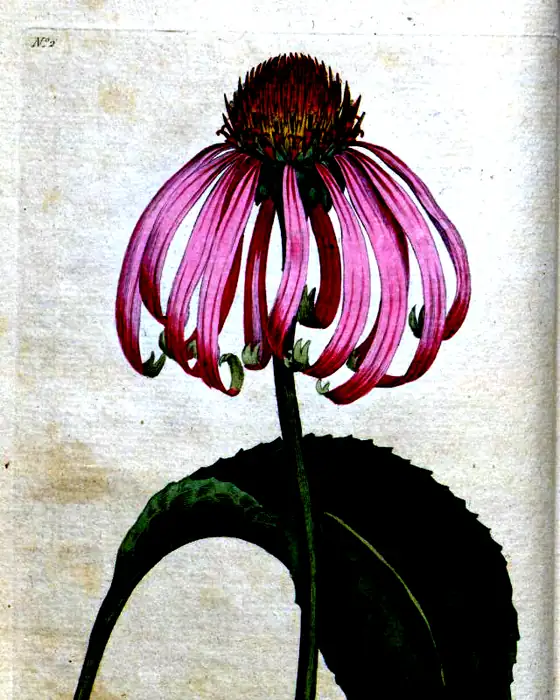
The purple coneflower of North American prairies, with drooping pink-purple petals around a spiny copper cone. The root sets the tongue tingling, a sign of the compounds that rouse first-line immunity at the start of an infection.
- Energetics
- Cooling, drying, tonifying
- Taste
- Bitter, then tingling
- Family
- Asteraceae (daisy family)
- Parts used
- Root and flowering tops
Medicinal uses 5
The tags sort the evidence behind each use by kind. Members are able to tap a condition to compare every herb for it.
TTraditional useLLab and mechanism studiesCClinical studies
Started at the first scratch of a cold, in frequent doses, it shortens and softens the illness.
Sprayed or gargled, it eases sore throats.
Cleans infected, slow-healing wounds and boils.
The Plains peoples' great remedy for snakebite and stings.
Plains nations chewed the root, which numbs as it tingles, and held it against an aching tooth.
Preparations
Root decoction, frequent tincture doses at the first sign of illness, and throat sprays.
Members are able to see the amounts, ratios, and methods for each preparation, search by condition, and match herbs to your constitution.
Cautions
- Daisy-family allergies can apply.
- It works best short-term, at the onset of illness, rather than as a daily preventive.
- Wild echinacea, especially the narrow-leaf species, has been heavily overharvested; choose cultivated purpurea.
Sourcing
United Plant Savers lists wild echinacea as at-risk after decades of root digging on the prairies. Purple coneflower grows easily in gardens and on farms, so buy cultivated root or grow your own.
Medication interactions
Practitioner Practitioners are able to see the one type of medicine flagged for echinacea, each with the mechanism and what to do. The plain-language cautions above stay open to everyone.
Pregnancy & breastfeeding
PregnancyShort-term only
A study of 206 women who took echinacea in pregnancy found no rise in birth defects. Short-term use for an acute cold is the usual approach, rather than daily prevention.
BreastfeedingShort-term only
Short-term use is low risk; avoid long stretches.
Practitioner Practitioners are able to see the full entry from the Moss Herbalism Pregnancy Safety Database: trimester ratings, uterine and placental action, breastfeeding and nursing-baby effects, chemistry, traditional use, studies, and sources.
Folklore
Plains peoples, among them the Lakota, Cheyenne, and Omaha, used the root for snakebite, toothache, and infected wounds, and the ethnobotanist Melvin Gilmore wrote in 1919 that it served more ailments than any other plant of the Missouri River region. In the late 1800s a Nebraska patent-medicine maker, H.C.F. Meyer, sold it as Meyer's Blood Purifier and offered to let a rattlesnake bite him to prove its worth. Eclectic physicians took it up from him. The name comes from the Greek echinos, hedgehog, for the spiny cone.
How to grow
A drought-tolerant perennial for full sun and well-drained soil. Seed germinates best after a winter outdoors or a month in the refrigerator. Harvest flowering tops at early bloom, and roots from plants three or four years old, in autumn.
In the wild
Prairies, glades, and open woods of central and eastern North America. Wild stands have been heavily dug, so buy from growers rather than harvest them.
Every herb here fits some people better than others. Find out which ones fit you.