← All plants
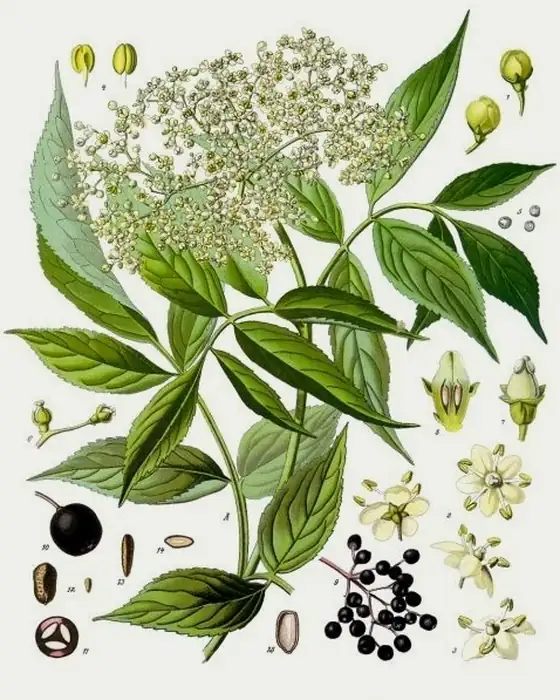
Archival plate of Sambucus nigra, from Köhler's Medizinal-Pflanzen, 1887 to 1898
The Moss Herbal Database
Sambucus nigra
Fam. Adoxaceae
Parts: Flowers and ripe berries, cooked
Plate: Köhler's Medizinal-Pflanzen, 1887 to 1898 ↗

Elder

Sambucus nigra
Also: Elderberry, Elderflower, Black elder, Sambucus canadensis
CoolingDryingRelaxing

Berries for the flu, flowers for the fever.

A fast-growing shrub with flat sprays of cream flowers in early summer and drooping clusters of dark berries by late summer. The berries help the body shut down viral infections early; the flowers relax the skin's surface so a fever can sweat itself out.

Energetics
Cooling, drying, relaxing
Taste
Sweet, sour, slightly astringent
Family
Adoxaceae (moschatel family)
Parts used
Flowers and ripe berries, cooked

Medicinal uses 7

The tags sort the evidence behind each use by kind. Members are able to tap a condition to compare every herb for it.

Traditional useLab and mechanism studiesClinical studies
  • Shortens colds and flu when started at the first sign; compounds in the berries keep viruses from entering cells.

  • Elderflower opens the pores and lets the heat of a fever release.

  • The flowers drain stuck fluid from the sinuses.

  • Elderflower calms seasonal allergies, a gentle choice for people who react to chamomile.

  • Elderflower lets hot, pent-up emotion like anger and frustration release, and lifts a heavy mood.

  • Helps the lymph clear the debris left behind after a cold.

  • A spoonful of elderberry syrup a day through cold season is a long folk habit across Europe.

Preparations

Cooked berry syrup, hot flower tea for fevers, elixirs and cordials.

Members are able to see the amounts, ratios, and methods for each preparation, search by condition, and match herbs to your constitution.

Cautions

  • Cook the berries. Raw or unripe berries, leaves, stems, and bark cause nausea and vomiting.
  • Use blue or black elders only; red-berried elder is more toxic.
  • Honey syrups are not for babies under one year.
  • Large amounts of fresh berries act as a purgative.

Medication interactions

Practitioner Practitioners are able to see the 2 types of medicine flagged for elder, each with the mechanism and what to do. The plain-language cautions above stay open to everyone.

Pregnancy & breastfeeding

PregnancyCooked berries and flowers

Cooked syrups and elderflower tea are widely used for colds in pregnancy. Avoid raw plant parts, and watch the sugar in commercial cordials if blood sugar is a concern.

BreastfeedingCooked preparations

Cooked syrup and flower tea are generally considered compatible with nursing.

Practitioner Practitioners are able to see the full entry from the Moss Herbalism Pregnancy Safety Database: trimester ratings, uterine and placental action, breastfeeding and nursing-baby effects, chemistry, traditional use, studies, and sources.

Folklore

In Danish and English tradition a spirit called the Elder Mother, Hylde-Moer, lives in the tree, and a woodcutter asked her leave before taking a branch, promising her some of his own wood when he became a tree himself. Furniture made from elder without her blessing was said to carry her along with it. Hollow elder stems made whistles and pea shooters, and the genus name may come from the sambuca, a Greek instrument. Charlemagne is said to have ordered elder planted on his estates as a living medicine cabinet.

How to grow

A fast, forgiving shrub for moist, rich soil in sun or part shade. Hardwood cuttings pushed into the ground in winter root readily. Leave plenty of flowers on the bush, or there will be no berries.

In the wild

Hedgerows, woodland edges, riverbanks, and disturbed ground. Black elder is native to Europe, western Asia, and northern Africa; American elder grows across eastern and central North America, and blue elder across the West.

Every herb here fits some people better than others. Find out which ones fit you.