← All plants
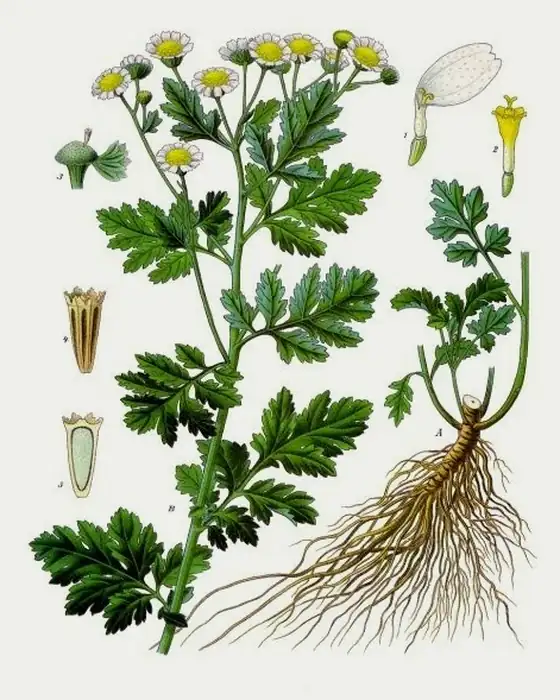
Archival plate of Tanacetum parthenium, from Köhler's Medizinal-Pflanzen, 1887 to 1898
The Moss Herbal Database
Tanacetum parthenium
Fam. Asteraceae
Parts: Leaves
Plate: Köhler's Medizinal-Pflanzen, 1887 to 1898 ↗

Feverfew

Tanacetum parthenium
Also: Featherfew, Bachelor's buttons, Midsummer daisy
CoolingDryingTonifying

Taken daily, it cuts how often migraines come.

A bushy, pungent little daisy with yellow-green, ferny leaves and clouds of small white-rayed flowers. Feverfew, taken every day for months, makes migraines less frequent and less fierce, and cools inflammation.

Energetics
Cooling, drying
Taste
Very bitter, aromatic
Family
Asteraceae (daisy family)
Parts used
Leaves

Medicinal uses 4

The tags sort the evidence behind each use by kind. Members are able to tap a condition to compare every herb for it.

Traditional useLab and mechanism studiesClinical studies
  • Taken daily, reduced the number of migraine attacks in several trials, though results vary by product.

  • Helps chronic headaches that come with heat and inflammation.

  • A traditional anti-inflammatory for arthritic joints.

  • Its old use, recorded in its name, was to cool a fever.

Preparations

Fresh leaves with food, daily capsules, and small tincture doses, taken for months.

Members are able to see the amounts, ratios, and methods for each preparation, search by condition, and match herbs to your constitution.

Cautions

  • Chewing fresh leaves causes mouth sores in some people; take them with food or in capsules.
  • Stopping suddenly after long use can bring rebound headaches and achy joints; taper off.
  • People allergic to ragweed or daisies can react to it, and it can thin the blood.

Medication interactions

Practitioner Practitioners are able to see the one type of medicine flagged for feverfew, each with the mechanism and what to do. The plain-language cautions above stay open to everyone.

Pregnancy & breastfeeding

PregnancyAvoid

Feverfew stimulates the uterus and slows clotting, so it is avoided in pregnancy.

BreastfeedingAvoid

Its anti-clotting action could reach a nursing baby, and safety research is lacking.

Practitioner Practitioners are able to see the full entry from the Moss Herbalism Pregnancy Safety Database: trimester ratings, uterine and placental action, breastfeeding and nursing-baby effects, chemistry, traditional use, studies, and sources.

Folklore

The name comes from the Latin febrifugia, fever-chaser. Plutarch tells of a workman who fell while building on the Acropolis and was healed with an herb the goddess Athena showed Pericles in a dream; the herb was called parthenium. Its modern revival began in 1970s Britain, when Anne Jenkins, wife of a coal board doctor, found that a few leaves a day ended her migraines; trials at the City of London Migraine Clinic followed.

How to grow

An easy, short-lived perennial for sun and well-drained soil that self-sows everywhere. Pick leaves as needed through the growing season; a few plants keep a household supplied.

In the wild

Native to the Balkans and western Asia, now escaped along walls, roadsides, and old gardens across Europe and North America.

Every herb here fits some people better than others. Find out which ones fit you.