← All plants
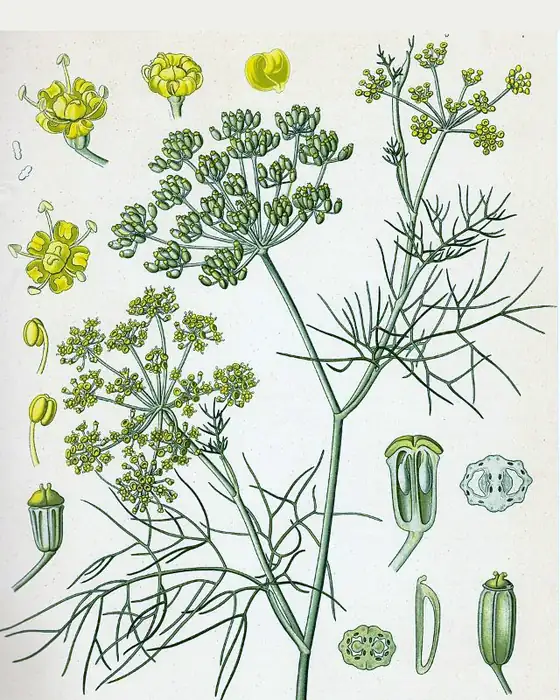
Archival plate of Foeniculum vulgare, from Köhler's Medizinal-Pflanzen, 1887 to 1898
The Moss Herbal Database
Foeniculum vulgare
Fam. Apiaceae
Parts: Seeds
Plate: Köhler's Medizinal-Pflanzen, 1887 to 1898 ↗

Fennel

Foeniculum vulgare
Also: Sweet fennel, Fennel seed
WarmingMoisteningRelaxing

The after-dinner seed that settles gas and cramping.

Feathery blue-green fronds on a tall hollow stalk, topped with flat yellow umbrellas that ripen into ridged, anise-scented seeds. Fennel warms a cold, slow gut, loosens spasm in the bowel and the womb, and thins sticky mucus.

Energetics
Warming, moistening, relaxing
Taste
Aromatic, pungent, sweet
Family
Apiaceae (carrot family)
Parts used
Seeds

Medicinal uses 7

The tags sort the evidence behind each use by kind. Members are able to tap a condition to compare every herb for it.

Traditional useLab and mechanism studiesClinical studies
  • Moves trapped gas and eases bloating, the reason fennel seeds are passed around after meals from India to Italy.

  • Calms a cramping, gassy bowel, including IBS with a lot of mucus in the stool.

  • Helps the liver and gallbladder handle rich, fatty meals.

  • Loosens period cramps; several small trials compare it well with common pain relievers.

  • A traditional milk-supply herb, usually blended with nettle and raspberry leaf.

  • Thins thick mucus so a chesty cough can clear it.

  • A few chewed seeds calm a queasy stomach.

Preparations

Crushed-seed tea, seeds chewed after meals, tincture, and gut blends.

Members are able to see the amounts, ratios, and methods for each preparation, search by condition, and match herbs to your constitution.

Cautions

  • People allergic to carrot, celery, or mugwort can react to fennel.
  • Fennel's anethole has weak estrogen-like activity; talk with your practitioner before taking medicinal amounts alongside a hormone-sensitive condition.
  • The essential oil is far stronger than the seed and is not taken internally at home.

Medication interactions

Practitioner Practitioners are able to see the one type of medicine flagged for fennel, each with the mechanism and what to do. The plain-language cautions above stay open to everyone.

Pregnancy & breastfeeding

PregnancyCulinary amounts

Fennel in cooking is a long-standing kitchen use through pregnancy. Medicinal-strength teas and the essential oil carry enough anethole to act like a weak estrogen, so those wait until after birth.

BreastfeedingA cup or two a day

A traditional milk-supply herb. Its anethole passes into milk, and two newborns whose mothers drank more than 2 liters a day of a nursing tea blend with fennel and anise became lethargic and fed poorly. Keep to a cup or two a day.

Practitioner Practitioners are able to see the full entry from the Moss Herbalism Pregnancy Safety Database: trimester ratings, uterine and placental action, breastfeeding and nursing-baby effects, chemistry, traditional use, studies, and sources.

Folklore

The Greek word for fennel was marathon, and the battle of 490 BCE was fought on a plain thick with it. In myth Prometheus smuggled fire to humanity inside the hollow stalk of a giant fennel. Charlemagne listed fennel among the plants to be grown on every imperial estate. In New England, families carried fennel, dill, and caraway seeds to Sunday meeting and chewed them through the long sermons, and the seeds were known as meetin' seeds.

How to grow

A short-lived perennial in mild climates, grown as an annual elsewhere. Sow in spring in full sun and well-drained soil, and keep it away from dill, which cross-pollinates with it. Gather the seed heads when the seeds turn from green to gray-brown, and dry them in a paper bag.

In the wild

Native to the Mediterranean and now wild along roadsides, coastal bluffs, and vacant lots in California, Australia, and other Mediterranean climates, where it spreads readily.

Every herb here fits some people better than others. Find out which ones fit you.