← All plants
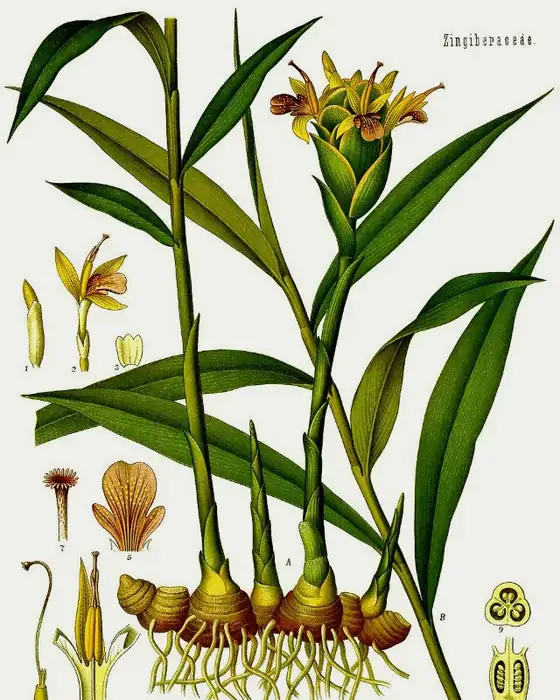
Archival plate of Zingiber officinale, from Köhler's Medizinal-Pflanzen, 1887 to 1898
The Moss Herbal Database
Zingiber officinale
Fam. Zingiberaceae
Parts: Rhizome
Plate: Köhler's Medizinal-Pflanzen, 1887 to 1898 ↗

Ginger

Zingiber officinale
Also: Ginger root
WarmingDryingRelaxing

Kindles a cold, sluggish gut and stops nausea in its tracks.

The knobbed rhizome of a tropical cousin of turmeric and cardamom. Ginger warms digestion, settles nausea of nearly every kind, and moves blood to cold hands and a cramping womb. Fresh root pushes warmth outward; dried root heats the core.

Energetics
Hot, drying, relaxing
Taste
Pungent, aromatic
Family
Zingiberaceae (ginger family)
Parts used
Rhizome

Medicinal uses 11

The tags sort the evidence behind each use by kind. Members are able to tap a condition to compare every herb for it.

Traditional useLab and mechanism studiesClinical studies
  • Settles nausea from motion, pregnancy, food poisoning, and medication.

  • Warms and speeds slow, heavy digestion and eases gas.

  • Eases menstrual cramps, especially with a scant, slow flow.

  • Warms chills and helps a fever build at the start of a cold.

  • Fresh root carries warmth out to cold hands and feet.

  • Eases achy, cold joints, inside and as a compress.

  • A hot ginger compress moves blood through bruises and strains.

  • Helps cold, constricted headaches.

  • A traditional postpartum warming food and milk support.

  • Eases the muscle soreness that follows hard work or exercise, and arthritic aches; trials support both.

  • Ginger powder taken at the first sign of a migraine worked about as well as sumatriptan in one trial.

Preparations

Fresh root tea, candied ginger, tincture, and hot compresses.

Members are able to see the amounts, ratios, and methods for each preparation, search by condition, and match herbs to your constitution.

Cautions

  • Ginger thins the blood; take care with blood-thinning medications.
  • It increases flow in periods that already run heavy.
  • Large amounts can bring on heartburn.

Medication interactions

Practitioner Practitioners are able to see the 2 types of medicine flagged for ginger, each with the mechanism and what to do. The plain-language cautions above stay open to everyone.

Pregnancy & breastfeeding

PregnancyFood amounts

The best-studied herb for morning sickness, with multiple clinical trials behind it. Food amounts are safe across all three trimesters; keep supplements to the modest doses used in studies, about half a teaspoon of powder a day, especially near delivery.

BreastfeedingGenerally compatible

A traditional postpartum food and galactagogue in many cultures, generally considered safe.

Practitioner Practitioners are able to see the full entry from the Moss Herbalism Pregnancy Safety Database: trimester ratings, uterine and placental action, breastfeeding and nursing-baby effects, chemistry, traditional use, studies, and sources.

Folklore

Ginger has never been found growing wild. It traveled west from Asia by sea and caravan as one of the first spices to reach the Mediterranean, and Rome taxed it at the border. In medieval England a pound of ginger cost about as much as a sheep. The Analects record that Confucius was never without ginger at his meals, and gingerbread men are credited to the court of Elizabeth I, who had them shaped to resemble her guests.

How to grow

A tropical perennial grown from a plump, budded piece of rhizome; organic grocery ginger works. Plant it shallowly in a wide pot of rich, loose soil and keep it warm, above 55°F (13°C), and humid. Harvest after eight to ten months, or break off pieces as needed. In cold climates it lives indoors and summers outside.

In the wild

Unknown in the wild. Ginger is a cultigen, domesticated in maritime Southeast Asia and carried across the tropics by Austronesian seafarers.

Every herb here fits some people better than others. Find out which ones fit you.