← All plants
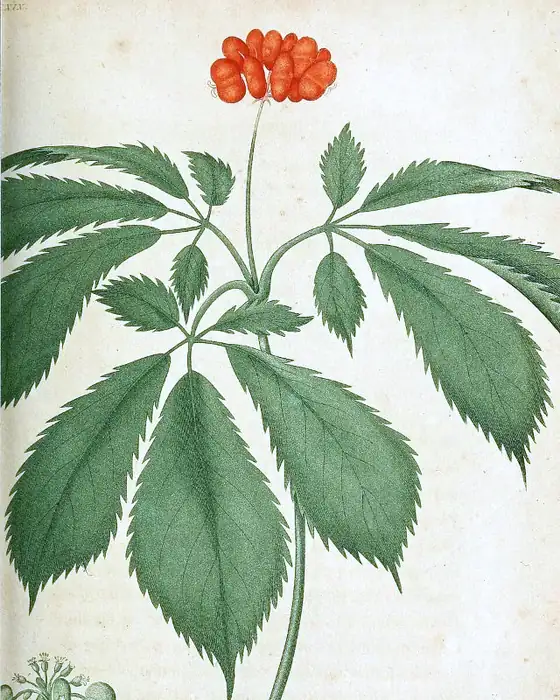
Archival plate of Panax quinquefolius, P. ginseng, from Bigelow, American Medical Botany, 1817 to 1820
The Moss Herbal Database
Panax quinquefolius, P. ginseng
Fam. Araliaceae
Parts: Root
Plate: Bigelow, American Medical Botany, 1817 to 1820 ↗

Ginseng

Panax quinquefolius, P. ginseng
Also: American ginseng, Asian ginseng, Korean ginseng, Ren shen
Warming and coolingMoisteningTonifyingAt-risk

The classic tonic root for stamina, focus, and blood sugar, now precious in the wild.

A slow woodland perennial with a whorl of five-fingered leaves, a cluster of red berries, and a forked, often human-shaped root that takes years to mature. Ginseng builds stamina, sharpens thinking, steadies blood sugar, and strengthens resistance to illness; American ginseng runs cooler and gentler, Asian ginseng warmer and more stimulating.

Energetics
American cooling and moistening, Asian warming; both toning
Taste
Sweet, slightly bitter
Family
Araliaceae (ivy family)
Parts used
Root

Medicinal uses 5

The tags sort the evidence behind each use by kind. Members are able to tap a condition to compare every herb for it.

Traditional useLab and mechanism studiesClinical studies
  • American ginseng eased cancer-related fatigue in a clinical trial, and both kinds restore stamina in long depletion.

  • Improved working memory and mental performance in small clinical trials.

  • American ginseng taken before a meal blunted the rise in blood sugar in clinical studies.

  • An American ginseng extract cut the number of colds in clinical trials.

  • Korean red ginseng improved erectile function in clinical trials.

Preparations

Root decoction, capsules in courses, and ginseng chicken soup.

Members are able to see the amounts, ratios, and methods for each preparation, search by condition, and match herbs to your constitution.

Cautions

  • Asian ginseng can be stimulating, bringing insomnia, jitteriness, headaches, and higher blood pressure in some people. Leave it out with uncontrolled high blood pressure.
  • Ginseng changes the effect of several medicines, warfarin and diabetes drugs among them; check with your prescriber.
  • Siberian ginseng, or eleuthero, is a different plant.

Sourcing

United Plant Savers lists wild American ginseng as at-risk, and it is protected under CITES, the treaty on trade in endangered species. Most states allow wild harvest only in autumn, of plants at least five years old, with their berries planted on the spot. Buy cultivated or woods-grown root.

Medication interactions

Practitioner Practitioners are able to see the 6 types of medicine flagged for ginseng, each with the mechanism and what to do. The plain-language cautions above stay open to everyone.

Pregnancy & breastfeeding

PregnancyAvoid

Ginseng compounds act weakly like hormones, and animal studies raised concerns about birth defects, so both American and Asian ginseng are avoided in pregnancy.

BreastfeedingAvoid

Ginseng's hormone-like effects and the lack of nursing data keep it out of breastfeeding.

Practitioner Practitioners are able to see the full entry from the Moss Herbalism Pregnancy Safety Database: trimester ratings, uterine and placental action, breastfeeding and nursing-baby effects, chemistry, traditional use, studies, and sources.

Folklore

Panax shares a root with panacea, Greek for all-healing, and the Chinese name ren shen means person root, for its human shape. In 1716 the Jesuit Joseph-François Lafitau, having read a description of Chinese ginseng, searched the woods near Montreal and found the American species, starting a trade that shipped tons of wild root to China. Daniel Boone dug and traded ginseng, and in 1788 a boatload of his roots went into the Ohio River when the boat overturned.

How to grow

A shade perennial for moist, rich, well-drained hardwood forest soil, much like goldenseal's. Seed takes 18 months to germinate, and roots need five to ten years to mature; woods-grown planting under living forest is the sustainable way.

In the wild

American ginseng grows in rich hardwood forests of eastern North America, from Quebec and Ontario south to Georgia and west to Oklahoma. Asian ginseng is nearly gone from the wild in northeastern China, Korea, and the Russian Far East.

Every herb here fits some people better than others. Find out which ones fit you.