← All plants
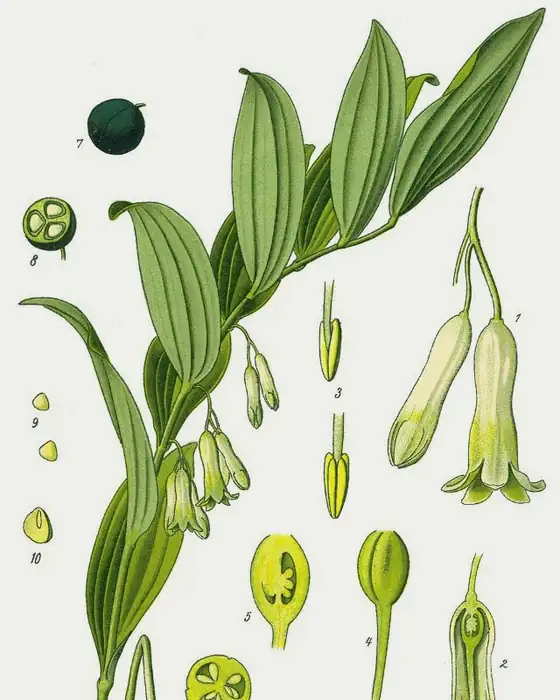
Archival plate of Polygonatum biflorum, from Thomé, Flora von Deutschland, Österreich und der Schweiz, 1885
The Moss Herbal Database
Polygonatum biflorum
Fam. Asparagaceae
Parts: Rhizome
Plate: Thomé, Flora von Deutschland, Österreich und der Schweiz, 1885 ↗

Solomon's seal

Polygonatum biflorum
Also: Smooth Solomon's seal, Polygonatum multiflorum, Sealwort
CoolingMoisteningRelaxingHarvest with care

Moistens dry joints and brings tendons and ligaments back to a healthy tension.

A woodland perennial whose arching stems hang pairs of greenish-white bells beneath the leaves, followed by blue-black berries. Its knobbly white rhizome bears round scars, the seals, where old stems fell away. Solomon's seal moistens and soothes dry, inflamed joints and brings connective tissue back to a healthy tension, whether it has gone slack or tight.

Energetics
Cooling, moistening, relaxing
Taste
Sweet, mucilaginous, slightly acrid
Family
Asparagaceae (asparagus family)
Parts used
Rhizome

Medicinal uses 3

The tags sort the evidence behind each use by kind. Members are able to tap a condition to compare every herb for it.

Traditional useLab and mechanism studiesClinical studies

Preparations

Fresh-rhizome tincture in small doses, liniments, and decoction.

Members are able to see the amounts, ratios, and methods for each preparation, search by condition, and match herbs to your constitution.

Cautions

  • Buy cultivated root or grow your own. Wild Solomon's seal grows slowly and is overharvested in many places.
  • The berries are mildly toxic; use only the rhizome.

Sourcing

Wild Solomon's seal spreads slowly, and its growing popularity has put pressure on wild stands. Buy cultivated root or grow your own; it is easy in a shady bed.

Medication interactions

Practitioner Practitioners are able to see the one type of medicine flagged for Solomon's seal, each with the mechanism and what to do. The plain-language cautions above stay open to everyone.

Pregnancy & breastfeeding

PregnancyAsk your practitioner

Solomon's seal has not been studied in pregnancy; check with your practitioner before taking it.

BreastfeedingAsk your practitioner

Little is known about it in breast milk; check with your practitioner first.

Folklore

The name comes from the round scars on the rhizome, left each year where the stem withers, which reminded early herbalists of a royal seal; one legend says King Solomon stamped the root to mark its virtues. Counting the scars gives a rough age for the plant. Its young shoots were once eaten like asparagus, a close relative.

How to grow

An easy, long-lived perennial for shade and rich, moist woodland soil. Plant pieces of rhizome just under the surface in fall, and it will spread slowly into handsome colonies. Dig rhizomes in autumn from established patches, taking only part and replanting the growing tips.

In the wild

Rich deciduous woods and shaded slopes of eastern and central North America. The European P. multiflorum and its hybrids are the common garden forms.

Every herb here fits some people better than others. Find out which ones fit you.