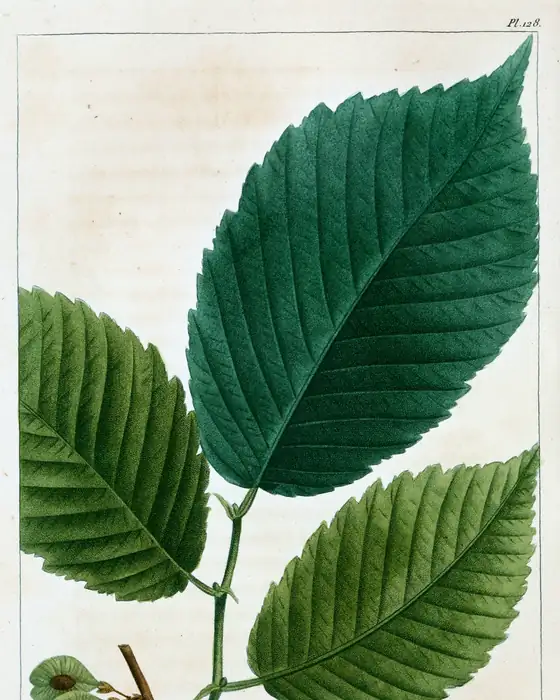
← All plantsSlippery elm
Ulmus rubra
Also: Red elm, Ulmus fulva
CoolingMoisteningRelaxingAt-risk
A nourishing, slippery bark that coats and soothes from throat to gut.
A medium-sized elm whose inner bark turns thick and slippery when wet and smells faintly of maple and fenugreek. Slippery elm coats and soothes irritated tissue from the throat to the gut, feeds those too ill to eat, and soothes and draws on the skin.
- Energetics
- Cooling, moistening, relaxing
- Taste
- Sweet, bland, mucilaginous
- Family
- Ulmaceae (elm family)
- Parts used
- Inner bark
Medicinal uses 6
The tags sort the evidence behind each use by kind. Members are able to tap a condition to compare every herb for it.
TTraditional useLLab and mechanism studiesCClinical studies
Coats the esophagus and stomach and eases reflux and heartburn.
Soothes an inflamed, ulcerated gut lining from the esophagus to the colon.
Lozenges and teas coat a raw, sore throat.
Calms a dry, tickling cough.
Its fiber firms loose stools, and it eases constipation too.
As a poultice, soothes burns, boils, and inflamed skin.
Preparations
Porridge, lozenges, and poultices.
Members are able to see the amounts, ratios, and methods for each preparation, search by condition, and match herbs to your constitution.
Cautions
- Its mucilage slows absorption of medicines taken at the same time; take them 2 hours apart.
Sourcing
United Plant Savers lists slippery elm as at-risk; Dutch elm disease and bark stripping have killed many trees. Marshmallow root does most of the same work, and Siberian elm, an abundant invasive tree in much of the U.S., can stand in for it.
Medication interactions
Practitioner Practitioners are able to see the one type of medicine flagged for slippery elm, each with the mechanism and what to do. The plain-language cautions above stay open to everyone.
Pregnancy & breastfeeding
PregnancyBy mouth
Slippery elm taken by mouth has no action on the uterus and is considered low risk. Its old reputation as an abortifacient came from inserting the bark, a dangerous practice unrelated to drinking or eating it.
BreastfeedingGenerally compatible
Generally considered compatible by mouth.
Practitioner Practitioners are able to see the full entry from the Moss Herbalism Pregnancy Safety Database: trimester ratings, uterine and placental action, breastfeeding and nursing-baby effects, chemistry, traditional use, studies, and sources.
Folklore
Native nations and settlers chewed the bark to ease thirst and hunger and packed wounds with it, and soldiers in the American Revolution are said to have survived on slippery elm porridge. Dutch elm disease, which reached North America around 1930, killed most of the great American elms, and slippery elms now rarely reach old age.
How to grow
A medium tree for sun and moist, rich soil, vulnerable to Dutch elm disease. Bark comes from cultivated trees or fallen branches; stripping a ring of bark around a living trunk kills the tree.
In the wild
Woods and river bottoms of eastern and central North America, from Quebec to Florida and west to the Dakotas and Texas.
Every herb here fits some people better than others. Find out which ones fit you.