← All plants
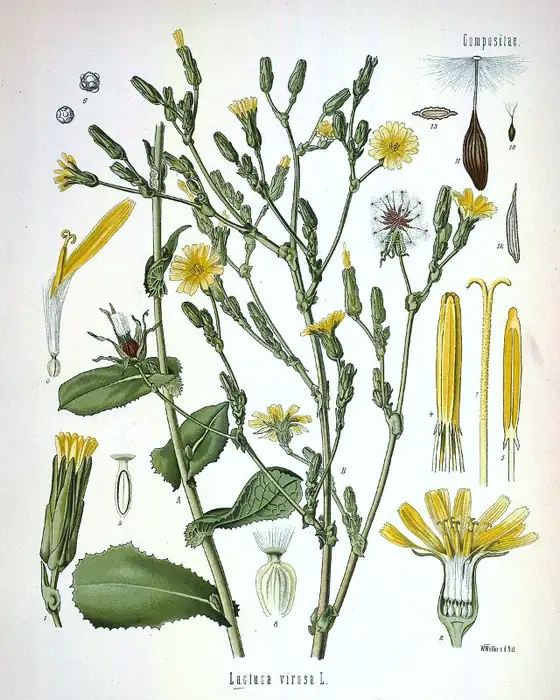
Archival plate of Lactuca virosa, from Köhler's Medizinal-Pflanzen, 1887 to 1898
The Moss Herbal Database
Lactuca virosa
Fam. Asteraceae
Parts: Leaves, stems, and milky sap
Plate: Köhler's Medizinal-Pflanzen, 1887 to 1898 ↗

Wild lettuce

Lactuca virosa
Also: Bitter lettuce, Opium lettuce, Lactucarium
CoolingDryingRelaxing

For the pain that won't let you sleep.

A tall, prickly biennial whose stems bleed a white, bitter latex when cut. Wild lettuce cools pain and quiets an agitated body enough for sleep, and its sap was once sold as a mild sedative.

Energetics
Cooling, drying, relaxing
Taste
Bitter
Family
Asteraceae (daisy family)
Parts used
Leaves, stems, and milky sap

Medicinal uses 4

The tags sort the evidence behind each use by kind. Members are able to tap a condition to compare every herb for it.

Traditional useLab and mechanism studiesClinical studies
  • Helps sleep come when pain or agitation keeps a person awake.

  • Takes the edge off nerve, muscle, and other stubborn pain.

  • Settles the restlessness and nerves that ride along with pain.

  • A traditional ingredient in syrups for a dry, nighttime cough.

Preparations

Bedtime tincture and tea that include the stems, and pain and sleep blends.

Members are able to see the amounts, ratios, and methods for each preparation, search by condition, and match herbs to your constitution.

Cautions

  • Leave it out with kidney disease.
  • Can deepen the effect of sedatives, sleep medicines, and alcohol; don't drive after a full dose.
  • Large amounts can cause dizziness and nausea.

Medication interactions

Practitioner Practitioners are able to see the one type of medicine flagged for wild lettuce, each with the mechanism and what to do. The plain-language cautions above stay open to everyone.

Pregnancy & breastfeeding

PregnancyAvoid

Its sedative action and the lack of pregnancy research keep it out of pregnancy.

BreastfeedingAvoid

Its sedative action could reach a nursing baby.

Folklore

Dried and sold as lactucarium, the sap was listed in the United States Pharmacopeia for about a century as a gentle sedative and cough remedy, and earned the name lettuce opium, though it contains no opiates. Ancient Egyptians grew a tall, milky lettuce as the sacred plant of Min, god of fertility, and set it before his statues.

How to grow

A biennial that forms a leafy rosette the first year and a tall flowering stalk the second. Sow in spring in full sun and ordinary soil. Gather leaves and stems as the stalk rises, before the flowers turn to fluff.

In the wild

Native to Europe and the Mediterranean; its cousin prickly lettuce grows along roadsides and waste ground throughout North America.

Every herb here fits some people better than others. Find out which ones fit you.