← All plants
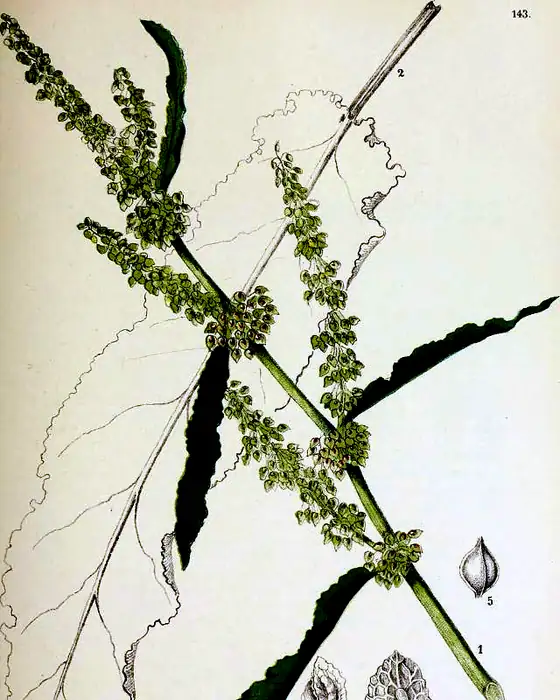
Archival plate of Rumex crispus, from Millspaugh, American Medicinal Plants, 1887
The Moss Herbal Database
Rumex crispus
Fam. Polygonaceae
Parts: Root
Plate: Millspaugh, American Medicinal Plants, 1887 ↗

Yellow dock

Rumex crispus
Also: Curly dock, Curled dock, Sour dock
CoolingDryingTonifying

Moves the bowels and builds the blood.

A tough roadside dock with long, wavy-edged leaves and tall spires of rust-colored seeds, over a yellow taproot that stains everything it touches. Yellow dock gets bile and the bowels moving, tones a slack gut, and helps the body take up iron.

Energetics
Cold, drying, toning
Taste
Bitter, acrid, astringent
Family
Polygonaceae (buckwheat family)
Parts used
Root

Medicinal uses 5

The tags sort the evidence behind each use by kind. Members are able to tap a condition to compare every herb for it.

Traditional useLab and mechanism studiesClinical studies
  • A gentle, non-habit-forming laxative that works mainly by moving bile; fresh-root tincture is strongest.

  • Helps the body absorb and use iron, a classic in iron-building syrups.

  • Stirs the liver and gallbladder in a slow, heavy digestion.

  • A long-standing remedy for skin that flares with a backed-up liver and gut.

  • As a water decoction its astringency firms loose bowels.

Preparations

Molasses iron syrup, fresh-root tincture for constipation, and decoction.

Members are able to see the amounts, ratios, and methods for each preparation, search by condition, and match herbs to your constitution.

Cautions

  • Contains oxalates; leave it out with a history of oxalate kidney stones.
  • Laxative doses can lower potassium over time; keep courses short.
  • Fatigue and pallor have many causes; get iron levels tested rather than guessing.

Medication interactions

Practitioner Practitioners are able to see the 2 types of medicine flagged for yellow dock, each with the mechanism and what to do. The plain-language cautions above stay open to everyone.

Pregnancy & breastfeeding

PregnancyWith your midwife

Herbalists have long given yellow dock syrup for iron in pregnancy at modest doses. Its mild laxative compounds call for care near delivery, so check with your midwife.

BreastfeedingModest doses

Keep to modest doses while nursing; strong laxative doses can loosen a baby's stools.

Practitioner Practitioners are able to see the full entry from the Moss Herbalism Pregnancy Safety Database: trimester ratings, uterine and placental action, breastfeeding and nursing-baby effects, chemistry, traditional use, studies, and sources.

Folklore

Farmers have long called it curly dock for its crimped leaf edges. Its root makes a yellow dye, and dock leaves rubbed on skin are the old English remedy for nettle stings, remembered in the old saying "in dock, out nettle." A single plant can set tens of thousands of seeds that stay viable in the soil for decades.

How to grow

Rarely planted, since it volunteers in nearly any field or garden. Dig the long taproot in autumn or early spring with a digging fork, and tincture it fresh or slice it to dry.

In the wild

Pastures, roadsides, ditches, and disturbed ground across Europe, Asia, and North America.

Every herb here fits some people better than others. Find out which ones fit you.