← All plants
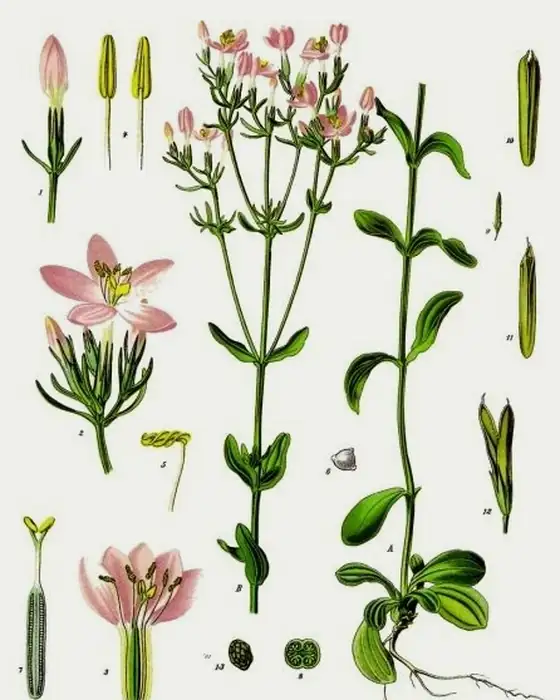
Archival plate of Centaurium erythraea, from Köhler's Medizinal-Pflanzen, 1887 to 1898
The Moss Herbal Database
Centaurium erythraea
Fam. Gentianaceae
Parts: Flowering tops
Plate: Köhler's Medizinal-Pflanzen, 1887 to 1898 ↗

Centaury

Centaurium erythraea
Also: Common centaury, European centaury
CoolingDryingTonifying

A pink-flowered gentian cousin for a poor appetite and slow digestion.

A small, upright annual or biennial with a basal rosette of leaves and clusters of starry pink flowers on branching stems. Centaury is a strong cooling bitter that wakes the appetite, sets the digestive juices flowing, and helps the body draw more nourishment from food; it can stand in for gentian, which is overharvested in the wild.

Energetics
Cooling, drying, toning
Taste
Very bitter
Family
Gentianaceae (gentian family)
Parts used
Flowering tops

Medicinal uses 3

The tags sort the evidence behind each use by kind. Members are able to tap a condition to compare every herb for it.

Traditional useLab and mechanism studiesClinical studies
  • Taken a few minutes before meals, it wakes a poor appetite and gets saliva, stomach acid, and bile flowing.

  • Clears the heavy, slow, incomplete digestion of a stomach that needs prompting.

  • By improving digestion, helps depleted, underweight people draw more nourishment from their food.

Preparations

Drop doses of bitters before meals, bitter tea, and warmed bitters blends.

Members are able to see the amounts, ratios, and methods for each preparation, search by condition, and match herbs to your constitution.

Cautions

  • Strongly cooling and drying; if you run cold and dry, blend it with warming herbs such as ginger.
  • Leave it out with active stomach or duodenal ulcers.

Medication interactions

Practitioner Practitioners are able to see the one type of medicine flagged for centaury, each with the mechanism and what to do. The plain-language cautions above stay open to everyone.

Pregnancy & breastfeeding

PregnancyAsk your practitioner

Centaury has not been studied in pregnancy; check with your practitioner before taking it.

BreastfeedingAsk your practitioner

Little is known about it in breast milk; check with your practitioner first.

Folklore

Centaurium is named for Chiron, the wise centaur of Greek myth who taught medicine to Asclepius and was said to have dressed his own wound with the plant. The species name erythraea means red, for its pink flowers. In the 1930s Edward Bach made centaury one of his flower remedies, for gentle people who find it hard to say no.

How to grow

A small annual or biennial for sun and dry, lean, well-drained soil. Sow in spring and barely cover the fine seed; it is slow to establish but self-sows once settled. Cut the flowering tops in summer.

In the wild

Dry grassland, dunes, chalk downs, and open woods of Europe, western Asia, and North Africa, and naturalized in parts of North America, especially along the West Coast.

Every herb here fits some people better than others. Find out which ones fit you.