← All plants
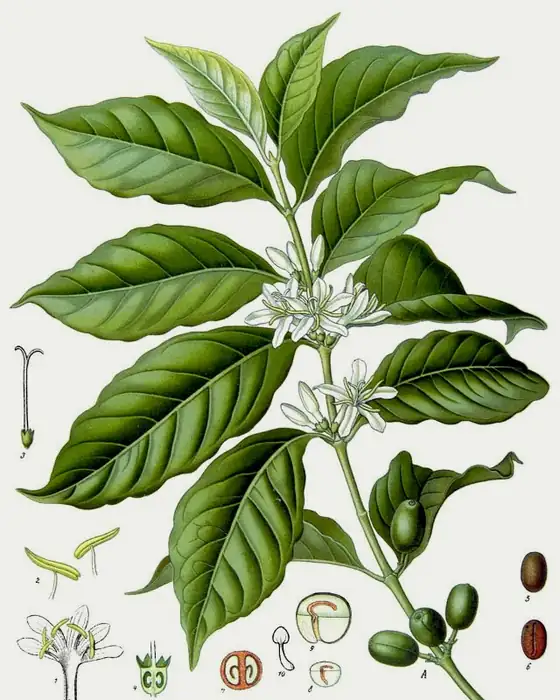
Archival plate of Coffea arabica, C. canephora, from Köhler's Medizinal-Pflanzen, 1887 to 1898
The Moss Herbal Database
Coffea arabica, C. canephora
Fam. Rubiaceae
Parts: Roasted seeds; leaves
Plate: Köhler's Medizinal-Pflanzen, 1887 to 1898 ↗

Coffee

Coffea arabica, C. canephora
Also: Arabica, Robusta, Coffee leaf
WarmingDryingTonifying

A bitter stimulant that sharpens the mind, moves the liver, and steadies blood sugar.

The roasted seeds of a glossy-leaved tropical shrub whose white, jasmine-scented flowers give way to red cherries. Coffee stimulates the nerves and circulation, stirs a sluggish liver and gallbladder, and its chlorogenic acids help steady blood sugar.

Energetics
Hot, drying, toning
Taste
Bitter, aromatic
Family
Rubiaceae (madder family)
Parts used
Roasted seeds; leaves

Medicinal uses 5

The tags sort the evidence behind each use by kind. Members are able to tap a condition to compare every herb for it.

Traditional useLab and mechanism studiesClinical studies
  • Caffeine sharpens alertness, attention, and reaction time.

  • People who drink coffee regularly develop type 2 diabetes less often in large population studies.

  • Its bitterness stirs the liver and gallbladder and gets stuck digestion moving.

  • Caffeine strengthens the pain relief of acetaminophen and aspirin in migraine, and a cup at the first sign helps some people.

  • Coffee drinkers form fewer kidney stones in population studies, partly through its diuretic effect.

Preparations

Filtered coffee, coffee leaf tea, and ways to soften its edge.

Members are able to see the amounts, ratios, and methods for each preparation, search by condition, and match herbs to your constitution.

Cautions

  • Caffeine tolerance varies widely; jitters, a racing heart, anxiety, reflux, or poor sleep mean it is time to cut back.
  • Unfiltered coffee, such as French press, Turkish, and espresso, carries cafestol, which raises LDL cholesterol.
  • Black coffee and a sweetened coffee drink are different things.
  • Choose organic, fair-trade beans, and water-processed decaf.

Medication interactions

Practitioner Practitioners are able to see the 5 types of medicine flagged for coffee, each with the mechanism and what to do. The plain-language cautions above stay open to everyone.

Pregnancy & breastfeeding

PregnancyUp to 200 mg caffeine

Up to about 200 mg of caffeine a day from all sources, roughly one 12-ounce cup of coffee, is the usual pregnancy limit; more is linked to lower birth weight.

BreastfeedingModerate amounts

Two or three cups a day are generally considered compatible. Caffeine builds up in young babies, so watch for wakefulness and fussing.

Folklore

Ethiopian legend tells of a goatherd named Kaldi whose goats danced after eating the red cherries. Sufi monks in Yemen were brewing coffee by the fifteenth century to stay awake through night prayers, and coffeehouses spread from Mecca to Cairo and Constantinople. In 1714 the Dutch gave Louis XIV a coffee tree for his greenhouse, and its offspring seeded the first plantations of the Caribbean.

How to grow

An evergreen shrub for shade, warmth, and steady rain that is killed by frost; it makes a handsome houseplant in bright, indirect light. The cherries ripen red about nine months after flowering, each holding two seeds.

In the wild

Arabica grows wild in the highland forests of southwestern Ethiopia and South Sudan; robusta in the lowland forests of central and western Africa.

Every herb here fits some people better than others. Find out which ones fit you.