← All plants
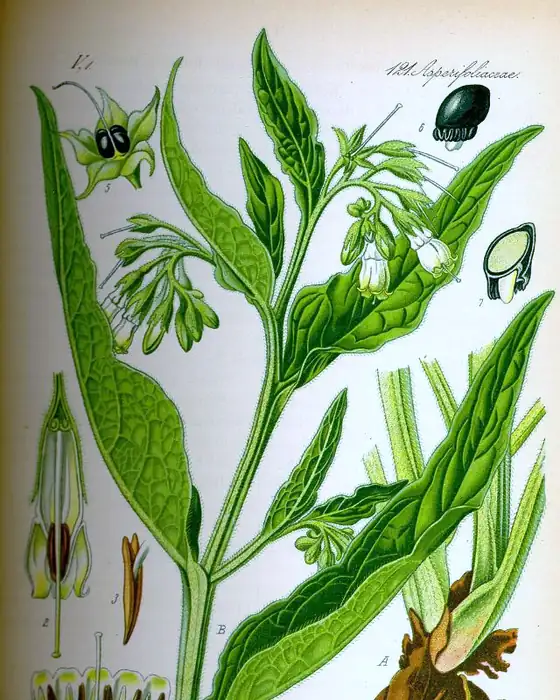
Archival plate of Symphytum officinale, from Thomé, Flora von Deutschland, Österreich und der Schweiz, 1885
The Moss Herbal Database
Symphytum officinale
Fam. Boraginaceae
Parts: Leaf and root, for use on the skin
Plate: Thomé, Flora von Deutschland, Österreich und der Schweiz, 1885 ↗

Comfrey

Symphytum officinale
Also: Knitbone, Russian comfrey, Symphytum x uplandicum
CoolingMoisteningTonifying

Knits sprains, strains, and bruised tissue, applied from the outside.

A big, bristly-leaved perennial with nodding clusters of purple, pink, or cream bells and a black-skinned root full of slippery mucilage. Applied to the skin, comfrey speeds the repair of sprains, strains, bruises, and broken bones, largely through allantoin, which drives new cell growth.

Energetics
Cooling, moistening, toning
Taste
Salty, mucilaginous, slightly bitter
Family
Boraginaceae (borage family)
Parts used
Leaf and root, for use on the skin

Medicinal uses 5

The tags sort the evidence behind each use by kind. Members are able to tap a condition to compare every herb for it.

Traditional useLab and mechanism studiesClinical studies
  • Comfrey ointment healed ankle sprains about as well as diclofenac gel in a clinical trial, and poultices and salves speed bruises and strains.

  • Rubbed into aching knees, comfrey root cream eased osteoarthritis pain and stiffness in trials.

  • Comfrey root cream relieved acute upper and lower back pain in a clinical trial.

  • Speeds new skin over clean, shallow scrapes; keep it off deep, puncture, or infected wounds.

  • A fresh leaf poultice or salve cools and helps heal small burns once the first heat has passed.

Preparations

Fresh leaf poultices, infused oil and salve, and standardized root creams, all for the skin.

Members are able to see the amounts, ratios, and methods for each preparation, search by condition, and match herbs to your constitution.

Cautions

  • For the skin only. Comfrey's pyrrolizidine alkaloids cause serious, sometimes fatal liver damage when taken by mouth, and internal products are banned or restricted in several countries.
  • Keep it off puncture wounds, deep wounds, and infected wounds; it closes the surface so quickly it can seal infection in.
  • Use raw-plant preparations on unbroken skin for no more than 4 to 6 weeks a year, the limit set by German regulators.
  • Young comfrey leaves look like foxglove, which is deadly; be sure of your plant.

Pregnancy & breastfeeding

PregnancyNever by mouth

Its pyrrolizidine alkaloids harm the liver and cross the placenta, so comfrey is never taken by mouth in pregnancy. Brief use on unbroken skin is considered low risk; check with your midwife.

BreastfeedingNever by mouth

The alkaloids pass into breast milk, so it is never taken by mouth while nursing. Keep salves off the breast.

Practitioner Practitioners are able to see the full entry from the Moss Herbalism Pregnancy Safety Database: trimester ratings, uterine and placental action, breastfeeding and nursing-baby effects, chemistry, traditional use, studies, and sources.

Folklore

Symphytum comes from the Greek for growing together, and the old name knitbone says the same. Country healers packed broken limbs in grated comfrey root, which sets hard as it dries, much like a plaster cast. Allantoin takes its name from the allantois, the fetal membrane where it was first found, and in the 1930s it was identified as the healing agent in the secretions of the maggots surgeons once used to clean wounds.

How to grow

A vigorous, deep-rooted perennial for sun or part shade and rich, moist soil. Plant it where you want it for good, since any scrap of root left in the ground regrows. Gardeners cut the leaves several times a summer for mulch and compost, and the sterile Russian comfrey 'Bocking 14' does not self-seed.

In the wild

Damp meadows, riverbanks, and ditches across Europe and western Asia, and naturalized along roadsides and around old gardens in North America.

Every herb here fits some people better than others. Find out which ones fit you.