← All plants
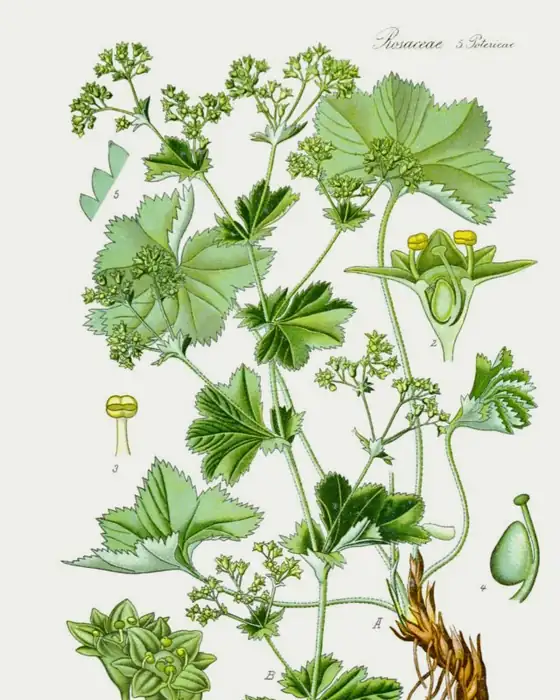
Archival plate of Alchemilla vulgaris, from Thomé, Flora von Deutschland, Österreich und der Schweiz, 1905
The Moss Herbal Database
Alchemilla vulgaris
Fam. Rosaceae
Parts: Leaves
Plate: Thomé, Flora von Deutschland, Österreich und der Schweiz, 1905 ↗

Lady's mantle

Alchemilla vulgaris
Also: Alchemilla, Lion's foot, Bear's foot
CoolingDryingTonifying

Firms the uterus and slows heavy bleeding.

Soft, pleated, fan-shaped leaves that hold beads of water at dawn, with froths of tiny chartreuse flowers. Lady's mantle tightens lax tissue, and it works most strongly on the uterus and the rest of the pelvis, easing heavy periods, firming the womb after birth, and steadying loose bowels.

Energetics
Cooling, drying, toning
Taste
Astringent, bitter
Family
Rosaceae (rose family)
Parts used
Leaves

Medicinal uses 6

The tags sort the evidence behind each use by kind. Members are able to tap a condition to compare every herb for it.

Traditional useLab and mechanism studiesClinical studies
  • Its astringency firms the uterus and helps reduce heavy flow.

  • After birth, firms the uterus as it shrinks back, and a sitz bath of the leaves helps torn tissue mend.

  • Firms loose bowels; a trial in young children with acute diarrhea found it shortened the illness.

  • Swished as a strong tea, tightens gums that bleed when you brush.

  • Gargled warm, soothes a raw, swollen throat.

  • Pressed onto a cut, the leaf draws the edges together and checks bleeding.

Preparations

Leaf tea before and during heavy periods, tincture, sitz baths, and cycle blends.

Members are able to see the amounts, ratios, and methods for each preparation, search by condition, and match herbs to your constitution.

Cautions

  • Its tannins can upset an empty stomach; take it with food.
  • Bleeding that soaks a pad an hour, bleeding between periods, or bleeding after menopause needs a medical look.

Medication interactions

Practitioner Practitioners are able to see the one type of medicine flagged for lady's mantle, each with the mechanism and what to do. The plain-language cautions above stay open to everyone.

Pregnancy & breastfeeding

PregnancyAvoid; near term only with a midwife

Its toning action on the uterus keeps it out of the first and second trimesters. Some midwives give it near term to prepare the uterus for labor, and that call belongs to them.

BreastfeedingModest amounts

Traditionally given after birth to help the uterus firm up. Lab studies show anti-estrogen activity, a reason to keep amounts modest while nursing.

Practitioner Practitioners are able to see the full entry from the Moss Herbalism Pregnancy Safety Database: trimester ratings, uterine and placental action, breastfeeding and nursing-baby effects, chemistry, traditional use, studies, and sources.

Folklore

The genus name comes from alchemy: alchemists collected the bright drops that bead on the leaves at dawn, pushed out through pores along the leaf edges, as heavenly water for their work. Medieval Europe saw the Virgin Mary's cloak in the scalloped leaf, and the plant became Our Lady's mantle. Most lady's mantles set seed without pollination, so a plant's offspring are copies of their mother.

How to grow

An easy perennial for sun or part shade and moist soil, at home along paths and borders. It self-sows freely; cut the flowers before they seed if you want less. Harvest leaves in summer and dry them flat.

In the wild

Mountain meadows, pastures, and damp grassland across northern and central Europe and western Asia, naturalized in parts of northern North America.

Every herb here fits some people better than others. Find out which ones fit you.