← All plants
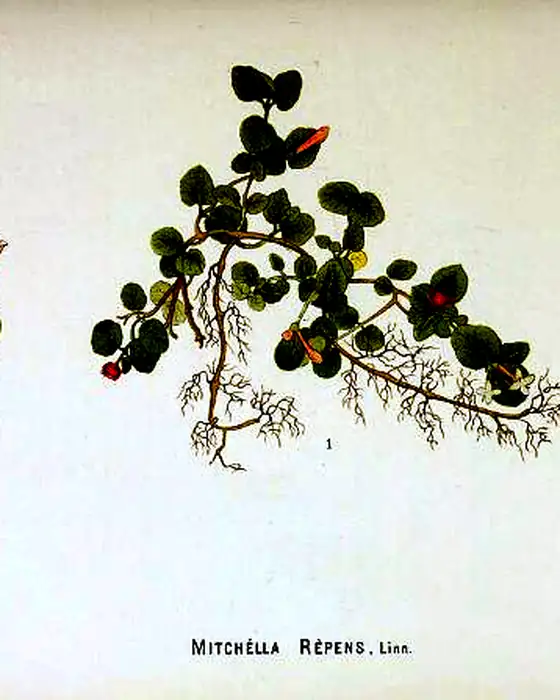
Archival plate of Mitchella repens, from Millspaugh, American Medicinal Plants, 1887, plate 77
The Moss Herbal Database
Mitchella repens
Fam. Rubiaceae
Parts: Leaves and stems
Plate: Millspaugh, American Medicinal Plants, 1887, plate 77 ↗

Partridgeberry

Mitchella repens
Also: Twinberry, Running box, Mitchella
CoolingDryingTonifyingTo-watch list

A tiny woodland vine that tones the uterus and bladder.

A creeping evergreen vine of the forest floor with small, round, white-veined leaves and paired white flowers whose ovaries fuse into a single red berry with two dimples. Partridgeberry tones the uterus, bladder, and pelvic floor, steadies heavy periods, and prepares the uterus for birth in the final weeks.

Energetics
Cooling, drying, toning
Taste
Astringent
Family
Rubiaceae (madder family)
Parts used
Leaves and stems

Medicinal uses 4

The tags sort the evidence behind each use by kind. Members are able to tap a condition to compare every herb for it.

Traditional useLab and mechanism studiesClinical studies

Preparations

Leaf tea and tincture in small amounts.

Members are able to see the amounts, ratios, and methods for each preparation, search by condition, and match herbs to your constitution.

Cautions

  • Bleeding or cramping in pregnancy needs prompt medical care.
  • Its tannins reduce iron absorption; take iron supplements a couple of hours apart.

Sourcing

Partridgeberry is on United Plant Savers' to-watch list and spreads slowly. Small doses do the work, so buy cultivated herb or take only a few runners from large, healthy patches.

Medication interactions

Practitioner Practitioners are able to see the one type of medicine flagged for partridgeberry, each with the mechanism and what to do. The plain-language cautions above stay open to everyone.

Pregnancy & breastfeeding

PregnancyFinal weeks, with guidance

Traditionally taken only in the last weeks of pregnancy, from about 36 weeks, to prepare the uterus for birth, and avoided earlier. Work with your midwife or OB.

BreastfeedingAsk your practitioner

A traditional postpartum tonic, but nursing has not been studied; check with your practitioner.

Practitioner Practitioners are able to see the full entry from the Moss Herbalism Pregnancy Safety Database: trimester ratings, uterine and placental action, breastfeeding and nursing-baby effects, chemistry, traditional use, studies, and sources.

Folklore

Linnaeus named the genus for John Mitchell, a Virginia physician and botanist who described many of the colony's plants. Each berry grows from two flowers whose ovaries fuse, so every fruit carries two small dimples where the flowers sat. The berries are edible but bland, and they hang on through winter for grouse and wild turkeys.

How to grow

A slow, creeping evergreen for deep shade and moist, acid, humus-rich soil; a fine ground cover under conifers. Gather leafy runners in summer, a few from each patch.

In the wild

Forest floors of eastern North America, from Nova Scotia and Ontario to Florida and Texas, often on mossy ground under conifers.

Every herb here fits some people better than others. Find out which ones fit you.