← All plants
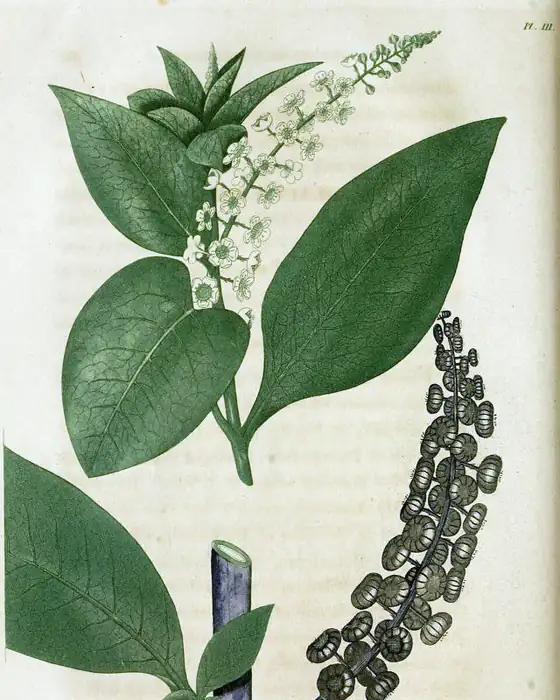
Archival plate of Phytolacca americana, from Bigelow, American Medical Botany, 1817 to 1820
The Moss Herbal Database
Phytolacca americana
Fam. Phytolaccaceae
Parts: Root
Plate: Bigelow, American Medical Botany, 1817 to 1820 ↗

Poke root

Phytolacca americana
Also: Pokeweed, Poke sallet, Inkberry
CoolingDryingTonifyingLow-dose herb

A powerful lymph mover in drop doses, and a poison in larger ones.

A towering native perennial with magenta stems, long drooping clusters of white flowers, and inky purple berries over a huge white taproot. Poke root is one of the strongest lymphatic herbs, moving stuck lymph in swollen glands and breasts, but it is toxic beyond drop doses.

Energetics
Cooling, drying, stimulating
Taste
Acrid, bitter
Family
Phytolaccaceae (pokeweed family)
Parts used
Root

Medicinal uses 2

The tags sort the evidence behind each use by kind. Members are able to tap a condition to compare every herb for it.

Traditional useLab and mechanism studiesClinical studies
  • Moves stubborn swollen glands and congested lymph, in drops and as a topical oil.

  • An Eclectic remedy, in drops, for swollen tonsils and throat infections.

Preparations

Drop doses of fresh-root tincture, and infused oil for the skin.

Practitioner Practitioners are able to see the amounts and methods for poke root. It is a low-dose herb, with a narrow margin between a helpful dose and a harmful one.

Cautions

  • Every part is poisonous, the root most of all. Too much causes vomiting, diarrhea, low blood pressure, and slowed breathing.
  • Children have been poisoned eating the berries; keep them away from the plant.
  • Wear gloves to handle fresh root; its proteins can enter through broken skin and affect blood cells.
  • Any breast lump needs a medical evaluation.

Medication interactions

Practitioner Practitioners are able to see the 2 types of medicine flagged for poke root, each with the mechanism and what to do. The plain-language cautions above stay open to everyone.

Pregnancy & breastfeeding

PregnancyAvoid

Poke is highly toxic, and its compounds act on immune cells and the uterus; it is never used in pregnancy.

BreastfeedingAvoid

Poke is not taken while nursing, and topical oil is kept off the breast during nursing.

Practitioner Practitioners are able to see the full entry from the Moss Herbalism Pregnancy Safety Database: trimester ratings, uterine and placental action, breastfeeding and nursing-baby effects, chemistry, traditional use, studies, and sources.

Folklore

In the American South, young poke shoots are still boiled twice, the water poured off each time, and eaten as poke sallet, the dish in Tony Joe White's song Polk Salad Annie. Some Civil War soldiers wrote letters home in the berry juice, which is why it is called inkberry. Birds eat the berries without harm and scatter the seeds widely.

How to grow

A huge, fast perennial of disturbed ground, field edges, and clearings that birds plant everywhere; not a plant for gardens where children play. Dig roots in autumn, wearing gloves.

In the wild

Fields, clearings, roadsides, and woodland edges across eastern North America, and naturalized in parts of Europe and Asia.

Every herb here fits some people better than others. Find out which ones fit you.