← All plants
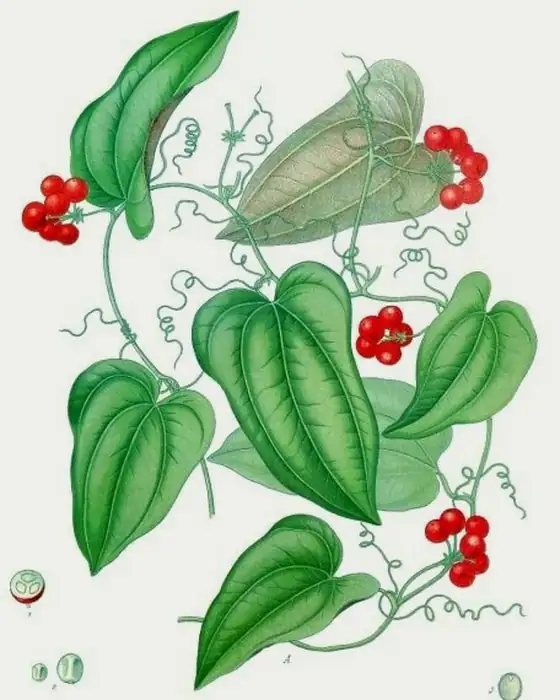
Archival plate of Smilax ornata, from Köhler's Medizinal-Pflanzen, 1887 to 1898
The Moss Herbal Database
Smilax ornata
Fam. Smilacaceae
Parts: Root
Plate: Köhler's Medizinal-Pflanzen, 1887 to 1898 ↗

Sarsaparilla

Smilax ornata
Also: Jamaican sarsaparilla, Smilax regelii, Zarzaparrilla
WarmingMoisteningTonifying

A warming root for the liver, the skin, and stiff, dry joints.

A prickly climbing vine of tropical American forests whose long, slender roots were dug, dried, and shipped to Europe by the ton. Sarsaparilla warms and moistens, stirs a sluggish liver, and clears chronic skin trouble and rheumatic stiffness over weeks of steady use.

Energetics
Warming, moistening, toning
Taste
Sweet, earthy, faintly bitter
Family
Smilacaceae (greenbrier family)
Parts used
Root

Medicinal uses 4

The tags sort the evidence behind each use by kind. Members are able to tap a condition to compare every herb for it.

Traditional useLab and mechanism studiesClinical studies
  • Warms and moves a stagnant liver and helps the body make more of its food.

  • A classic alterative for chronic psoriasis and eczema; a 1940s clinical report found it cleared or improved psoriasis in many patients.

  • Moistens and eases stiff, dry, rheumatic joints over long use.

  • Part of long-term blends for stubborn breakouts.

Preparations

Root decoction, homemade root beer syrup, and tincture.

Members are able to see the amounts, ratios, and methods for each preparation, search by condition, and match herbs to your constitution.

Cautions

  • Its saponins can upset the stomach in large amounts.
  • Buy true Smilax. Indian sarsaparilla (Hemidesmus) and wild sarsaparilla (Aralia nudicaulis) are different plants sold under the same name.

Medication interactions

Practitioner Practitioners are able to see the 3 types of medicine flagged for sarsaparilla, each with the mechanism and what to do. The plain-language cautions above stay open to everyone.

Pregnancy & breastfeeding

PregnancyAsk your practitioner

Sarsaparilla has a long history as a tonic and flavoring, but pregnancy has not been studied; check with your practitioner before medicinal doses.

BreastfeedingAsk your practitioner

Little is known about it in breast milk; check with your practitioner before medicinal doses.

Folklore

Its Spanish name, zarzaparrilla, joins zarza, bramble, and parrilla, little vine. In the sixteenth century Spanish ships carried the root to Europe as a celebrated cure for syphilis. In nineteenth-century America it flavored a fizzy tonic drink sold at soda fountains and Western saloons, a cousin of root beer.

How to grow

A tropical evergreen climber that needs warmth and moisture year-round; outside the tropics it is a greenhouse plant. Roots are dug from wild and cultivated vines and dried in bundles.

In the wild

Rainforests of Mexico and Central America, with related species across the Caribbean and South America. North America's greenbriers are temperate cousins in the same genus.

Every herb here fits some people better than others. Find out which ones fit you.