← All plants
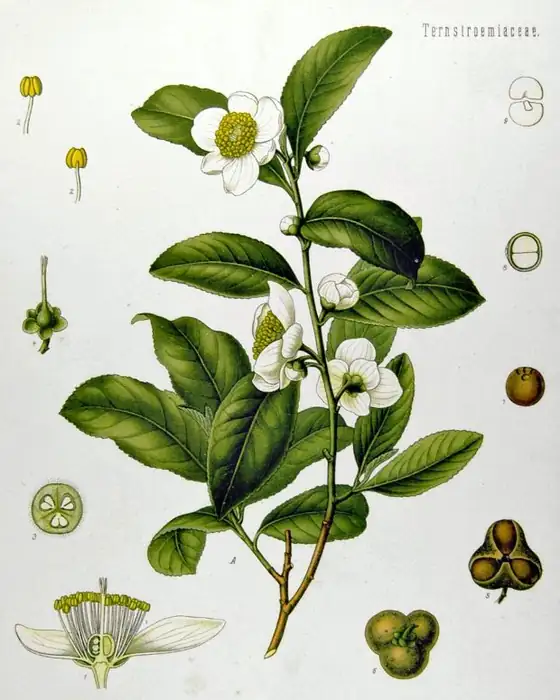
Archival plate of Camellia sinensis, from Köhler's Medizinal-Pflanzen, 1887 to 1898
The Moss Herbal Database
Camellia sinensis
Fam. Theaceae
Parts: Leaves
Plate: Köhler's Medizinal-Pflanzen, 1887 to 1898 ↗

Tea

Camellia sinensis
Also: Green tea, Black tea, White tea, Oolong
WarmingDryingTonifying

Calm, alert focus in a cup, with a long record for heart health.

The young leaves of an evergreen camellia, wilted, rolled, and dried into green tea or left to oxidize into oolong and black. Tea pairs caffeine with L-theanine, sharpening attention while keeping the edge off, and its catechins protect the heart and vessels over a lifetime of cups.

Energetics
Warming, drying, toning (green tea runs cooler than black)
Taste
Astringent, bitter, grassy to malty
Family
Theaceae (tea family)
Parts used
Leaves

Medicinal uses 4

The tags sort the evidence behind each use by kind. Members are able to tap a condition to compare every herb for it.

Traditional useLab and mechanism studiesClinical studies
  • Caffeine and L-theanine together sharpen attention and reaction time with fewer jitters than caffeine alone; trials support the pairing.

  • Regular tea drinkers have less heart disease; one meta-analysis tied each daily cup of green tea to about 5% lower risk.

  • Strong black tea is a household astringent for loose bowels.

  • Cooled black tea bags or compresses dry weepy rashes such as poison ivy.

Preparations

Green and black tea, matcha, and cooled black tea compresses.

Members are able to see the amounts, ratios, and methods for each preparation, search by condition, and match herbs to your constitution.

Cautions

  • Caffeine can bring on jitters, poor sleep, and a racing heart in sensitive people; keep tea to the morning if sleep suffers.
  • Concentrated green tea extract pills have caused liver injury; brewed tea has not.
  • Tannins reduce iron absorption, so drink tea between meals if your iron runs low.
  • For decaf, choose tea decaffeinated with carbon dioxide, which keeps more of the leaf's other compounds.

Medication interactions

Practitioner Practitioners are able to see the 5 types of medicine flagged for tea, each with the mechanism and what to do. The plain-language cautions above stay open to everyone.

Pregnancy & breastfeeding

PregnancyModerate amounts

A cup or two a day is considered compatible, counted toward a total of no more than 200 mg of caffeine a day from all sources. Concentrated green tea extracts, which can interfere with folate, are avoided.

BreastfeedingModerate amounts

One or two cups a day are generally considered compatible. Caffeine passes into milk, so watch for a wakeful, fussy baby, and skip extract pills.

Practitioner Practitioners are able to see the full entry from the Moss Herbalism Pregnancy Safety Database: trimester ratings, uterine and placental action, breastfeeding and nursing-baby effects, chemistry, traditional use, studies, and sources.

Folklore

Chinese legend credits the emperor Shennong with discovering tea around 2737 BCE, when leaves drifted into his pot of boiling water. Lu Yu wrote the first book devoted to it, the Classic of Tea, in the eighth century. In 1848 the botanist Robert Fortune, working for the East India Company, smuggled tea plants and skilled workers out of China to start plantations in India. Green, white, oolong, and black tea all come from this one plant; only the handling differs.

How to grow

An evergreen camellia for part shade and acid, well-drained soil; its hardier forms survive to about 0°F. Pick the top two leaves and a bud from new shoots in spring and early summer, then wilt, roll, and dry them for green tea, or let them oxidize for black.

In the wild

Native to the mountains where China, Myanmar, and northeast India meet, where ancient wild tea trees still grow. It is farmed across the wet subtropics, from China and India to Sri Lanka and Kenya.

Every herb here fits some people better than others. Find out which ones fit you.