← All plants
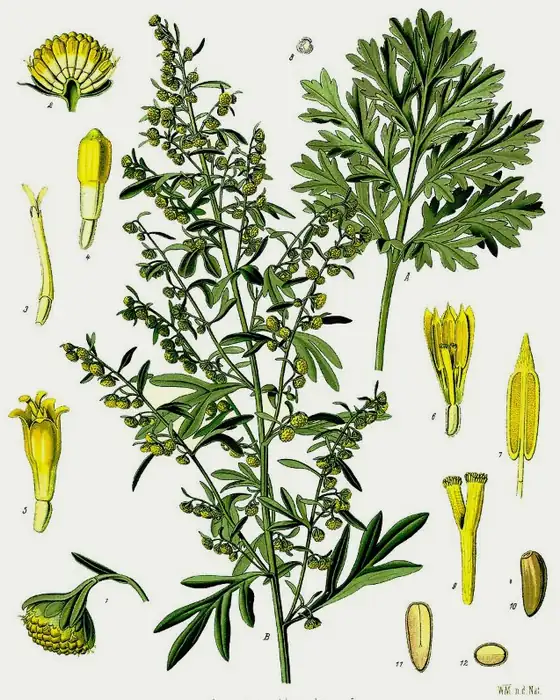
Archival plate of Artemisia absinthium, from Köhler's Medizinal-Pflanzen, 1887 to 1898
The Moss Herbal Database
Artemisia absinthium
Fam. Asteraceae
Parts: Leaves and flowering tops
Plate: Köhler's Medizinal-Pflanzen, 1887 to 1898 ↗

Wormwood

Artemisia absinthium
Also: Absinthe wormwood, Grand wormwood
CoolingDryingTonifying

One of the bitterest herbs, in drop doses, for a stalled appetite and stomach.

A silvery, aromatic perennial with finely divided, downy gray-green leaves and nodding yellow flower heads. Wormwood is among the bitterest plants known; a few drops wake a dull appetite and stir digestion, and it has long been used to drive out intestinal worms.

Energetics
Cooling, drying, toning
Taste
Intensely bitter, aromatic
Family
Asteraceae (daisy family)
Parts used
Leaves and flowering tops

Medicinal uses 2

The tags sort the evidence behind each use by kind. Members are able to tap a condition to compare every herb for it.

Traditional useLab and mechanism studiesClinical studies

Preparations

Drop doses of bitters before meals, a weak short-steeped tea, and moth bundles.

Members are able to see the amounts, ratios, and methods for each preparation, search by condition, and match herbs to your constitution.

Cautions

  • Use small doses for no more than four weeks at a time. Its thujone, concentrated in the essential oil, can cause seizures and kidney damage in large amounts.
  • Never take the essential oil internally.
  • Leave it out with seizure disorders, kidney disease, or stomach ulcers.
  • People allergic to ragweed or other daisy-family plants may react to it.

Medication interactions

Practitioner Practitioners are able to see the one type of medicine flagged for wormwood, each with the mechanism and what to do. The plain-language cautions above stay open to everyone.

Pregnancy & breastfeeding

PregnancyAvoid

Wormwood stimulates the uterus, carries thujone, and has a long history as an abortifacient, so it is avoided throughout pregnancy.

BreastfeedingAvoid

Thujone could reach a nursing baby; it is left out completely while nursing.

Practitioner Practitioners are able to see the full entry from the Moss Herbalism Pregnancy Safety Database: trimester ratings, uterine and placental action, breastfeeding and nursing-baby effects, chemistry, traditional use, studies, and sources.

Folklore

Artemisia honors Artemis, Greek goddess of the hunt and of childbirth. Its German name, Wermut, gave us vermouth, first flavored with wormwood. In 1573 the English farmer-poet Thomas Tusser advised strewing it on chamber floors to drive out fleas. France banned absinthe, the green wormwood spirit blamed for madness, in 1915, but analyses of old bottles have since found too little thujone to explain it; the harm came from the alcohol itself.

How to grow

A hardy, drought-tolerant perennial for full sun and lean, well-drained soil. Its roots release compounds that stunt nearby plants, so give it a spot apart from the vegetable bed. Cut the leafy tops just as it begins to flower.

In the wild

Dry waste ground, roadsides, and pastures across Europe, western Asia, and North Africa, and naturalized across much of North America, where some states list it as a noxious weed.

Every herb here fits some people better than others. Find out which ones fit you.