Published
Plant medicine is older than writing. The timeline below follows it from a cave burial in Iraq to the herbal schools of today, with the texts and herbalists that carried it from one era to the next.
I.Before writing
~60,000 BCE
Prehistoric herbalism
A burial in Shanidar Cave in Iraq held pollen from medicinal plants like yarrow and ephedra, possibly the earliest evidence of intentional herbal use, though some archaeologists dispute the interpretation. Oral traditions in foraging societies passed plant knowledge down around the world.
- Tea tree, Australia
- Kava, Polynesia
- Coca, the Andes
- White sage, California
A living tradition
Indigenous herbal traditions, the oldest living systems
Long before written records, Indigenous peoples around the world practiced sophisticated herbal medicine rooted in direct relationship with land, spirit and story. Knowledge passed through apprenticeship, ceremony and oral tradition. These systems continue today, though they are often marginalized or appropriated by Western herbal frameworks.
- Devil’s claw and hoodia, San and Khoi of southern Africa
- Noni and kava, Polynesia and Melanesia
- Echinacea, sweetgrass and white sage, North America
- Ayahuasca, coca and uña de gato, Amazonia
II.The first herbals
~3000 BCE
Egypt and the first documented herbal texts
The Ebers Papyrus (c. 1550 BCE) lists over 850 plant remedies. Healing was deeply tied to religion and ritual, and many formulas invoked gods or protective spirits. The papyrus also covers surgical methods, cosmetics and aromatic plant use.
- Garlic
- Aloe
- Cannabis
- Myrrh
~2500–200 BCE
Ayurveda develops in India
Rooted in oral tradition and codified in the Charaka Samhita and Sushruta Samhita (compiled around 600–200 BCE), Ayurveda describes hundreds of herbs and centers on constitution (the doshas), digestion and seasonal rhythms. It is still widely practiced.
- Turmeric
- Ashwagandha
- Tulsi
~2000 BCE
Traditional Chinese Medicine
Herbal knowledge is attributed to Shennong, the mythic herbalist emperor. The Shennong Ben Cao Jing (around 200 CE, Han dynasty) classifies herbs by taste, temperature and organ affinity.
- Astragalus
- Ginseng
- Reishi
- Licorice
~500 BCE
Greece: rational herbalism and humoral theory
Hippocrates advanced health through diet, herbs and the balance of the four humors. Theophrastus catalogued hundreds of plants in Historia Plantarum.
- Mint
- Willow
- Fennel
~100 CE
Rome: expansion and codification
Dioscorides wrote De Materia Medica, which stayed in use for over 1,500 years. Romans spread herbal knowledge through conquest, trade and infrastructure like baths and roads, carrying southern European herbs across the empire.
III.Keeping the knowledge
200–1000 CE
Monastic and Islamic preservation
Christian monasteries kept physic gardens and copied Greek and Roman texts by hand during Europe’s intellectual decline. In the Islamic world, regulated apothecary shops appeared in Baghdad around 754 CE.
- Sage
- Valerian
- Comfrey
- Lavender
1000–1400
Medieval herbalism
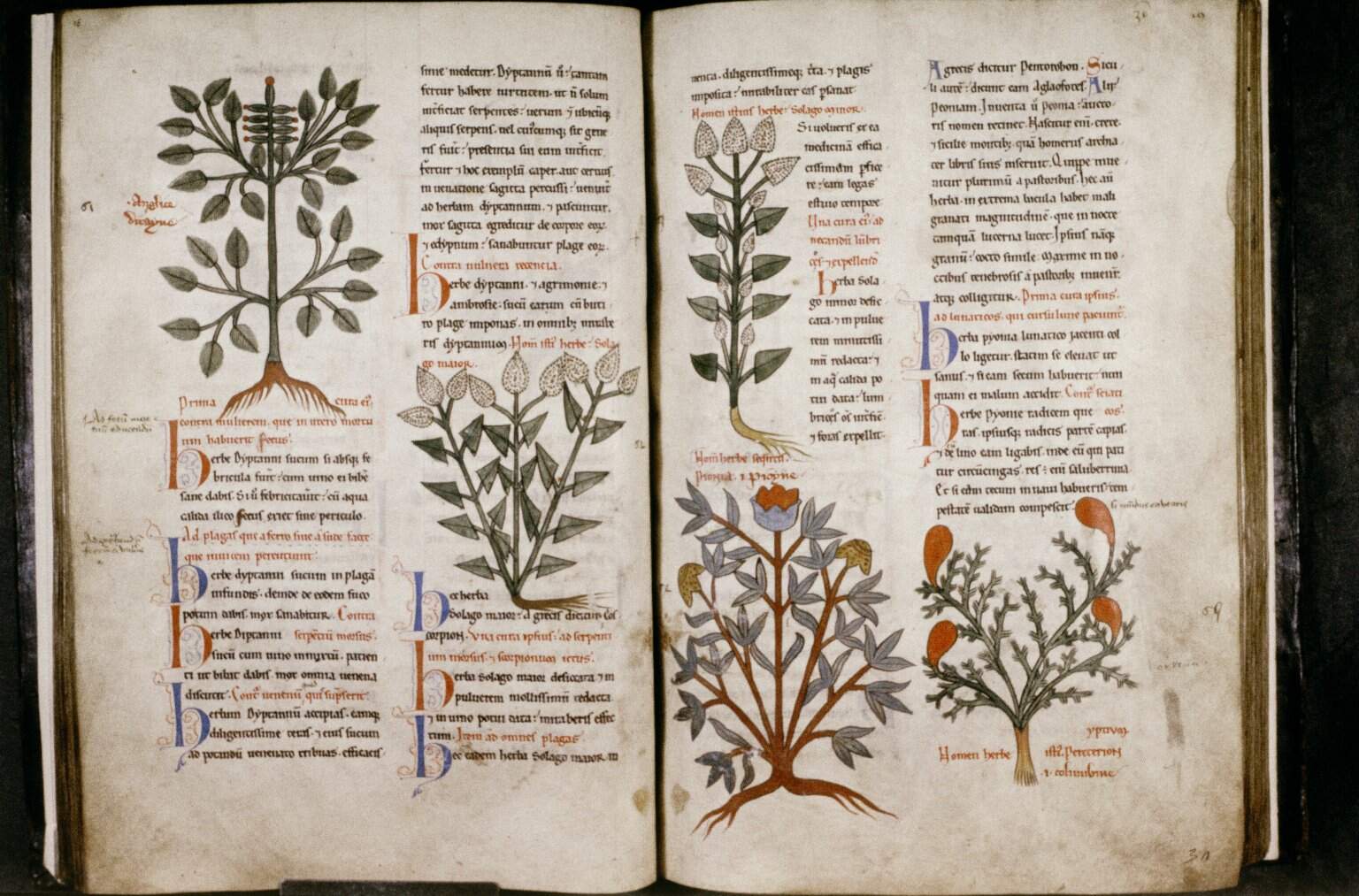
Avicenna (Ibn Sina) wrote the Canon of Medicine, synthesizing Greco-Roman and Persian knowledge, and Europe used it into the 1600s. Hildegard von Bingen (1098–1179) wrote Physica, blending herbal energetics and theology. Illustrated herbals like the Leechbooks and the Tacuinum Sanitatis circulated widely, and women’s folk healing traditions persisted outside formal institutions, often under persecution.
Plant names with wort and officinalis mark the medicinal herbs and the official herbs of the apothecary, as in St. John’s wort and Melissa officinalis.
1400–1600
The Renaissance and the printing revolution
The printing press spread herbal education widely, with Leonhart Fuchs’s De Historia Stirpium (1542) and John Gerard’s Herball (1597). Botanical gardens and the academic study of plants began to replace folk use, and colonization brought herbs like cacao, tobacco and cinchona to Europe.
Famous herbalists in history
People searching for famous herbalists in history usually meet a short list of names that made it into print. Hildegard of Bingen wrote Physica in the twelfth century, weaving monastic observation with plant practice. Avicenna’s Canon of Medicine shaped how plant remedies were taught across continents. Leonhart Fuchs and John Gerard put illustrated herbals into the hands of a wider European readership. Nicholas Culpeper later wrote for ordinary households rather than only physicians. Apothecaries carried that knowledge at the counter; see the history of the apothecary for how the shop and the craft grew together. Much of the work never got a famous name: village healers, midwives, and family practitioners who tested plants season after season without a title page.
- 980–1037AvicennaPersian physician
The Canon of Medicine - 1098–1179Hildegard of BingenRhineland abbess
Physica - 1501–1566Leonhart FuchsGerman physician
De Historia Stirpium, 1542 - c. 1545–1612John GerardEnglish herbalist
The Herball, 1597 - 1616–1654Nicholas CulpeperLondon apothecary
The English Physitian, 1652
IV.Plants become chemistry
1600–1800
Apothecaries and colonial exchange
Apothecaries were trusted healthcare providers working with whole plant remedies. Colonists learned from Indigenous healers and midwives, then often suppressed them, and folk, enslaved and Indigenous medicine continued in secret or syncretized forms.
1700s
The Linnaean naming system
Carl Linnaeus standardized botanical classification with two-part binomial names, like Hypericum perforatum for St. John’s wort and Valeriana officinalis for valerian.
1800s
The birth of modern pharmacology
Chemists isolated active constituents from medicinal plants, and the shift toward reductionism began: single molecules in place of whole plants.
- Morphine from opium
- Quinine from cinchona
- Salicin from willow bark
- Digitalis, atropine and others
1900–1940
Decline of herbal medicine in the West
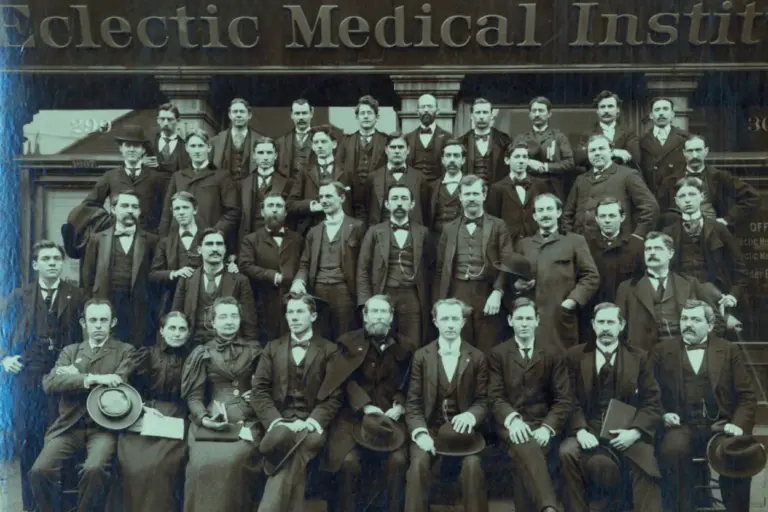
The Flexner Report (1910) led to the closure of herbal, Black, Indigenous and homeopathic schools. Herbalism was labeled unscientific and driven out of medical education, and the Eclectic and Thomsonian doctors persisted briefly in the U.S. before disappearing.
V.The revival
1950s–1970s
The herbal lull
Pharmaceuticals dominated medicine. Herbalism survived mainly through immigrants, rural communities and family transmission, and many herbal remedies were dismissed as old wives’ remedies.
1960s–1980s
Revival and counterculture
Back-to-the-land, natural birth and feminist movements revived folk medicine. Herbalists like Juliette de Bairacli Levy, Jethro Kloss, Susun Weed, Rosemary Gladstar and Michael Tierra inspired new generations, with a focus on reclaiming ancestral practices, sovereignty and whole-person care.
1980s–1990s
Professionalization and industry growth
Formal herbal schools and publications multiplied. United Plant Savers formed in 1994 to protect endangered herbs. Companies like Herb Pharm and Mountain Rose Herbs raised standards for herbs and preparations while widening access, and herbal education began to blend Western, TCM and Ayurvedic traditions.
2000s–2010s
Clinical herbalism and wider access
Clinical herbalists began working with lab tests, drug interaction safety and individualized energetics. Online courses and schools carried herbal education across the internet, the DSHEA Act of 1994 shaped how herbs could be marketed, and botanical medicine entered some functional and naturopathic practices.
2020s
Conscious practice and digital platforms
The focus has shifted toward bioregional herbalism, sustainability and land rematriation, with a resurgence of BIPOC, queer and Indigenous-led herbal collectives. Herbal education and misinformation both spread quickly through social media, and the climate crisis, ecological grief and resilience are now central themes in herbal work.
Resources for herbal texts
Ancient and classical
- Ebers PapyrusEgypt, c. 1550 BCECyril P. Bryan translation (HathiTrust)The medical features (Internet Archive)
- Charaka SamhitaIndiaOnline editionP.V. Sharma translation (Internet Archive)
- Sushruta SamhitaIndiaKaviraj Kunja Lal Bhishagratna translation (Internet Archive)Sanskrit edition (NIIMH)
- Shennong Ben Cao JingChinaEnglish translation (Internet Archive)Overview (PDF)
- Historia Plantarum, TheophrastusGreeceEnglish translation (Internet Archive)
- De Materia Medica, DioscoridesRoman EmpireTranslation (PDF, Internet Archive)
Medieval and Renaissance
- Physica, Hildegard von Bingen12th centuryEnglish translation (Internet Archive)
- The Canon of Medicine, Avicenna11th centuryInternet Archive
- De Historia Stirpium, Leonhart Fuchs1542Cambridge Digital Library
- The Herball, John Gerard1597Internet Archive